
What Bridge Technologies’ twenty-two-year commitment to IP broadcast monitoring reveals
Being right about the future is one thing. Building technology that remains relevant when that future finally arrives is quite another.
In a recent article, Bridge Technologies reflects on more than two decades of championing IP broadcast technology, drawing a distinction between being dogged and being dogmatic. It is an interesting observation, not least because the broadcast industry has spent much of those two decades navigating the transition from established hardware infrastructures towards increasingly flexible, software-defined production environments.
But the real significance of Bridge’s story is not simply that the company anticipated the industry’s migration towards IP. It is that Bridge understood something equally important: predicting the direction of technological change does not mean being able to predict precisely how, when or through which technologies that change will happen.
And confusing those two things can turn even the most visionary technology strategy into a liability.
The danger of being right too early
When Bridge Technologies began advocating IP-based broadcast workflows twenty-two years ago, SDI was firmly established. It was reliable, familiar and supported by an extensive infrastructure. The industry had little immediate reason to abandon it.
Yet Bridge recognised that IP would eventually provide the foundation for more flexible, scalable and interconnected production environments. That conviction proved well founded. But being right about the destination did not automatically make the journey straightforward.
The market needed time to develop the infrastructure, expertise and operational confidence required to embrace IP production. Standards needed to mature. Workflows needed to evolve. And the economic and practical arguments for migration needed to become sufficiently compelling.
This is where technological conviction can become dangerous.
Companies that believe strongly in a particular future can become impatient with the present. They may develop sophisticated technologies but insist that customers adopt them according to the manufacturer’s vision rather than their own operational readiness. The result can be an excellent technology that struggles to find its market.
Bridge took a different approach.
The vision was IP, not a particular route to IP
ST 2110 has become central to professional IP production, but the evolution of broadcast and ProAV has demonstrated that no single standard can address every operational requirement.
SRT provides different possibilities for transporting video across networks. IPMX extends professional IP media capabilities into ProAV environments with their own infrastructure and workflow considerations. By incorporating these technologies into the VB440, Bridge has demonstrated that commitment to IP does not require exclusive allegiance to one implementation.
This is an important distinction.
A technological vision should define the problem a company intends to solve and the capabilities it wants to deliver. It should not unnecessarily restrict the standards, platforms or deployment models through which those capabilities become available. Otherwise, a vision risks becoming a constraint on the very innovation it was intended to inspire.
In an industry increasingly dependent on interoperability, the ability to accommodate different technological approaches is not a concession. It is a competitive strength.
The VB440 illustrates the difference between architecture and delivery
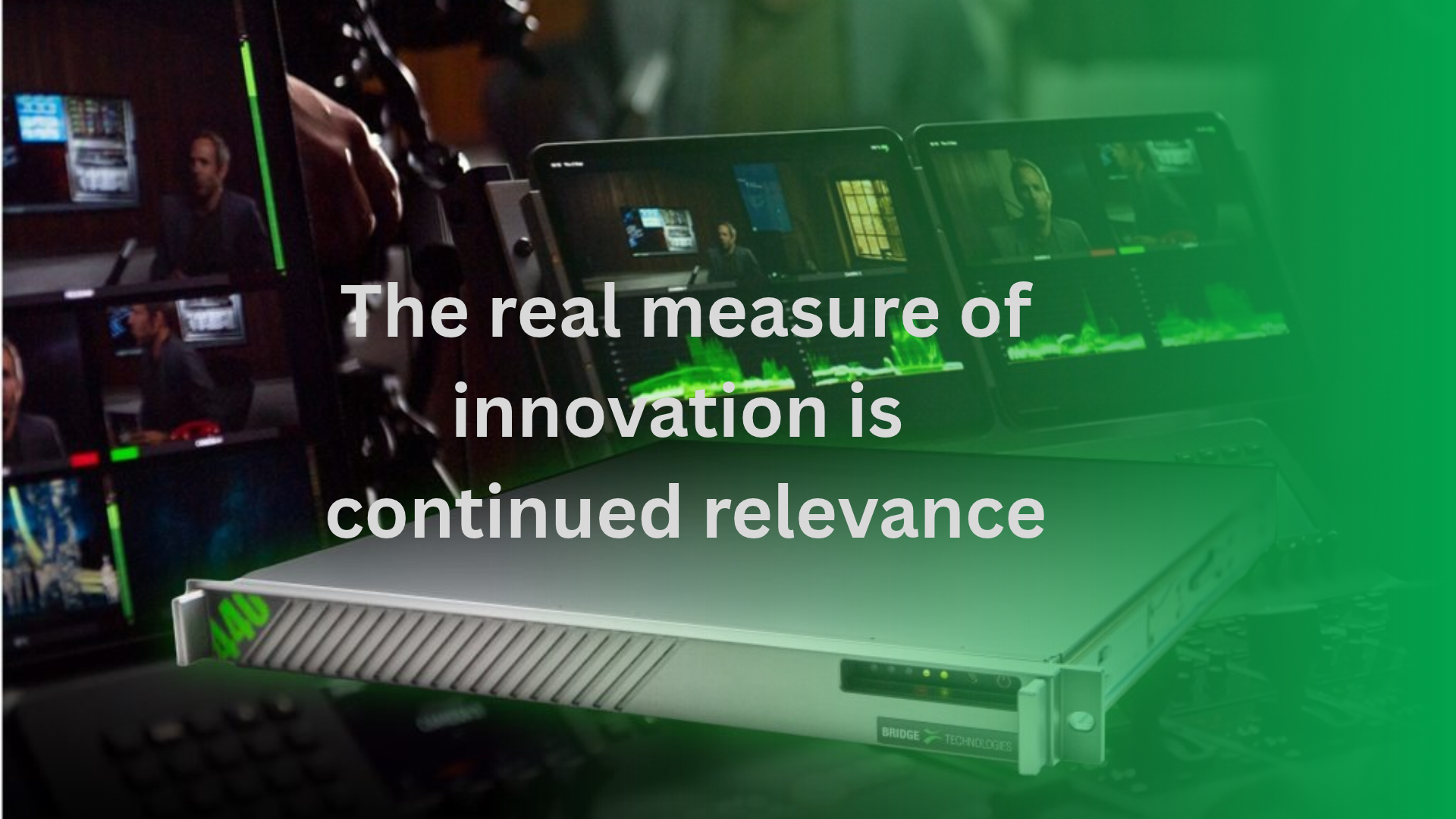
Perhaps the clearest demonstration of this philosophy is the VB440 itself. Although conceived as software technology, the VB440 was initially delivered through a dedicated 1RU appliance.
Why?
Because at the time, many broadcasters lacked the IT infrastructure and operational resources required to deploy and manage sophisticated production software independently. The appliance provided a convenient, reliable and immediately accessible way to benefit from the VB440’s comprehensive monitoring and analysis capabilities. Crucially, however, the appliance did not define the technology. It was simply the most appropriate way to deliver it.
Today, as broadcasters embrace virtualisation, containerisation and software-defined infrastructure, that original architectural decision has acquired new significance. The VB440 can now operate as a software-based solution on shared COTS infrastructure, allowing broadcasters to expand access and capacity according to their requirements.
Its participation in MXL-driven initiatives and integration with Grass Valley’s AMPP ecosystem extends those possibilities further, enabling production teams to access sophisticated audio and video analysis tools within on-demand, multi-vendor environments.
The technology has not abandoned its original purpose. The market has developed new ways to access its capabilities. And therein lies the distinction between designing a product for a particular moment and developing a technology architecture capable of remaining relevant beyond it.
The real measure of innovation is continued relevance
Technology companies naturally focus their communications on what is new. New products. New features. New standards. New performance benchmarks. Yet innovation is not exclusively about novelty.
There is considerable value in designing technologies that can accommodate changing requirements without demanding that customers repeatedly replace their existing investments. There is also value in recognising when a new deployment model, standard or market application can extend the usefulness of an established technological foundation.
This is particularly relevant as broadcast production becomes increasingly software-defined and interconnected. The competitive advantage may no longer lie solely in the performance of an individual product, but in the flexibility with which its capabilities can be integrated, accessed, scaled and combined with other production tools.
In this context, the evolution of the VB440 is more than a story about the transition from appliance to software. It illustrates how architectural foresight can translate into long-term commercial and operational relevance.
Being dogged is a strategy. Being dogmatic is a risk.
There is a broader business lesson here. A company without a clear vision risks becoming reactive, constantly adjusting its direction to accommodate the latest market trend. But a company that treats its original strategy as immutable faces an equally serious danger. It may become so committed to its chosen route that it fails to recognise alternative ways of achieving the very objective it set out to pursue.
The challenge is not to choose between conviction and flexibility. It is to understand that they serve different purposes.
Conviction determines what a company believes is worth achieving. Flexibility determines how successfully that belief can be translated into practical value as circumstances change.
Bridge Technologies’ twenty-two-year commitment to IP broadcast monitoring provides a useful example of how these qualities can coexist. The vision remained consistent. The standards expanded. The deployment models evolved. And the underlying technology found new applications as the market matured.
Vision without tunnel vision
At Xpresso Communications, we find the most interesting technology stories are rarely confined to what a product can do today. They are also about the decisions that shaped its development, the assumptions that proved correct, the approaches that needed reconsideration and the ability to recognise opportunities that were not necessarily visible at the beginning.
This is why Bridge’s distinction between being dogged and being dogmatic resonates beyond broadcast technology.
As the company observes, being dogged means holding firm to the belief that things can be better. Being dogmatic means refusing to acknowledge that there may be more than one path to achieving that improvement. And perhaps the most important lesson is this.
The value of technological foresight is not measured by how accurately a company predicts the future, but by how well the technology it builds can accommodate the future it cannot predict.
That is what turns a vision into a lasting competitive advantage.
Read the original Bridge Technologies article: Dogged, Not Dogmatic – Why You Should Stick to Your Guns but Keep Your Target Open