
Why audiences now notice every flaw and only reward creativity that goes beyond technical perfection
Spoilt audiences
Audiences are increasingly spoilt. Advances in camera technology mean that a crisp, dynamically contrasted, beautifully detailed shot no longer catches the attention of the viewer. Image precision has become the default.
Now, audiences are more likely to register the deficiency in a shot than they are to acknowledge its excellence. Think about the uproar that occurred after Game of Thrones‘ ‘Long Night’ episode was aired, where audiences complained as much about the boring shot choices and confusing, shadowy, compressed images as they did the unexpected plot developments.
The same is true of live sports. Audiences find themselves constantly frustrated by blurring and artefacts during high-speed movement, a lack of coherency and colour matching between multi-camera setups, and glare and blow-out in sun-drenched stadiums hit by shadowy corners.
In essence, it really doesn’t take much to annoy an audience. But it takes a lot to impress them.
Creative Differences
This means that in terms of keeping audiences happy and achieving competitive advantage, the options open to production teams are becoming increasingly limited. They can’t just be good, though they need to be.
They have to be different.
The answer? Creativity. It will be creative vision – as much or even more than technological quality – which will drive differentiation in the years to come. It’s that driving idea which has guided PROTON’s product development roadmap since they were established in 2024. The team, drawing on decades of combined experience in the field of miniature broadcast-grade cameras, recognised that the industry was saturated with cameras that delivered technical excellence but offered little in the way of creative flexibility. Their aim was to maintain that visual excellence but make it mini – whilst keeping full, European-driven control over their R&D focus.
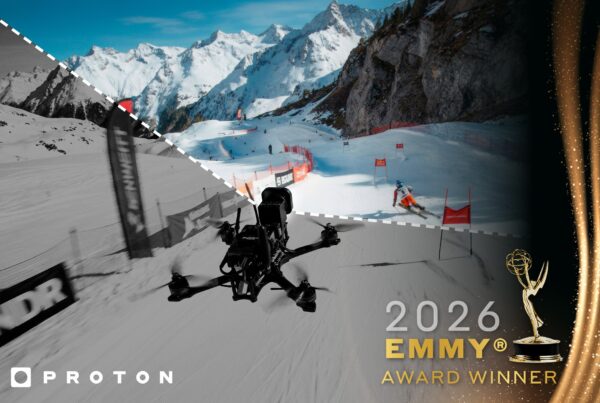
Of course, in many fields miniaturisation has constituted an almost gimmicky form of technological development – the kind done ‘just to see if we can’ (anybody remember the ‘fingerheld’ Xun Chi 138, or the iPod shuffle silliness which saw them eliminate all of the buttons in their third generation model, only to quickly backtrack in the next iteration?). But in broadcast, miniaturisation has real and meaningful application. A camera small enough to mount on a goalpost captures the raw physics of a penalty kick. A camera light enough to fly on an FPV drone weaves through a rally stage at speed. A camera discreet enough to sit inches from a chess grandmaster’s hand elevates intellectual tension into visual drama. Miniaturisation, when done properly, is not about shrinking for the sake of it; it’s about access.
What’s crucial though, is that this creativity is delivered reliably. A stunning shot delivered by a camera that is innovatively located but susceptible to the shocks and vibrations of its environment ultimately provides a net wash in terms of benefit. The rain and snow of a winter sports event, the constant jostling of a BMX helmet – these environments demand a camera that can survive them. Knowing this drove PROTON to create the PROTON RAIN, with its fully weather-sealed housing, ensures that creative ambition does not have to be tempered by environmental reality. Robustness is not a secondary consideration; it is the foundation upon which creative risk-taking is built.
From gimmick to genuine innovation
Now, PROTON are looking further afield for the next source of creative differentiation. It turns out it’s one that has been around for a while, but yet to find its footing: 3D cinematography. Like miniaturisation, it was once treated as gimmicky, and for exactly the same reason: too many attempts to implement it in places where it didn’t bring real benefit, in ways that weren’t effective, using technology that wasn’t mature enough. After one too many false starts, audience scepticism set in.
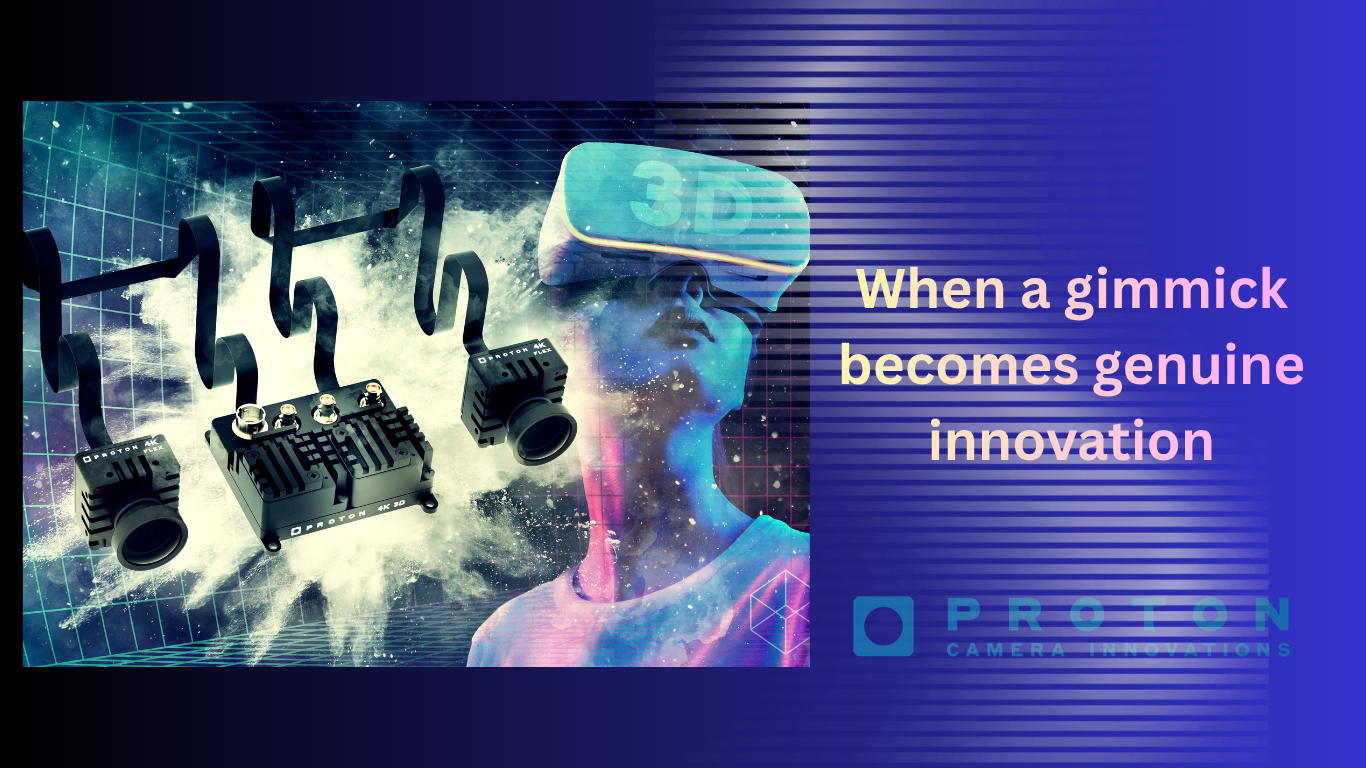
But with lessons learned and technology matured, we’re reaching a point where meaningfully deployed 3D technology has the opportunity to truly wow audiences. PROTON’s approach is built around pairing two PROTON 4K Flex cameras, sharing a single CCU. This proprietary architecture achieves frame-accurate synchronisation between both sensors at every frame – the essential foundation of comfortable and convincing stereoscopic depth. Colour, shading and exposure need only be adjusted on the ‘master’ camera, while a single power supply feeds the entire rig. The result is a 3D system that is not a technical compromise but a creative tool – one already in use on a major upcoming film production.
Ultimately, when audiences are placed inside a scene rather than simply watching it, whether that be from above, from a particular PoV or unusual angle, or with 3D immersion, what was once considered potentially gimmicky now becomes genuine innovation: the kind of innovation that genuinely changes the game.
Article covered by InBroadcast