
Who’s Making the Leap, Who’s Holding Back, and Why
Not every facility is ready to go all-IP, and that’s OK
The broadcast industry is in the midst of its most significant architectural shift in decades. The transition from SDI to IP-based production promises greater flexibility, scalability, and efficiency – but the path forward looks different for every facility. According to Haivision’s 2026 Broadcast Transformation Report, while 82 per cent of broadcast professionals continue to leverage SDI, 39 per cent now cite transitioning to IP as their top technology priority for the year ahead. But the reality is not a simple binary of ‘migrated’ versus ‘not migrated’. Instead, the industry is navigating a spectrum of approaches shaped by operational context, resources, and strategic priorities.
Who Is Transitioning to IP – and Why
As those statistics above show, a significant portion of the industry remains on SDI, and for entirely rational reasons. Smaller production houses, regional broadcasters, and facilities with tight capital constraints often find that SDI continues to meet their needs reliably. The technology is understood, the infrastructure is paid for, and the operational workflows are deeply embedded.
There is also a practical skills consideration. IP introduces networking disciplines that many broadcast engineers were not originally trained in. In an SDI world, connecting a cable often solved the problem. In IP, configuration, protocol alignment, and network behaviour determine success. Building that expertise takes time and investment – resources that not every facility has available while maintaining day-to-day operations.
The Hybrid Reality
Between these extremes lies the operational reality for most broadcasters: hybrid environments where SDI and IP coexist. This is not a transitional phase to be rushed through – for many facilities, it is a stable long-term state.
Consider a typical production facility today. Cameras might be native IP, but the router is SDI. Graphics systems speak SDI, but audio has moved to Dante. Outside broadcast trucks bring IP-native signals that must integrate with a facility still wired for SDI. Remote production workflows deliver IP streams that need to be monitored alongside locally generated SDI sources.
This hybrid approach reflects a pragmatic philosophy. The question is not which side wins. It is how to deploy the two together to deliver the flexibility, scalability, and reliability that modern content production actually requires.
How Bridge Technologies Supports the Entire Spectrum
Each of these operational contexts demands different things from monitoring and production tools.
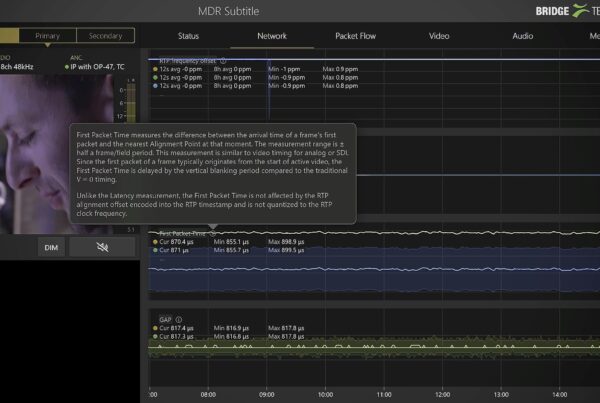
For the IP-native facility, the priority is deep visibility into ST 2110 streams: packet-level analysis, PTP timing verification, and the ability to capture and dissect network behaviour when issues arise. Engineers need to see not just the video, but the behaviour of the streams themselves. And it needs to do so in a way that is intuitive – thus avoiding the ‘knowledge gap’ issue which can prove to be such a substantial barrier to adoption.
For those still rooted in SDI, the VB440 does not demand abandonment, but instead invites production facilities to move towards a hybrid environment; one where their SDI-rooted tools can be encapsulated in IP. This means organisations can leverage their existing infrastructure whilst still gaining the remarkable benefits of IP: all with a certainty provided for by the VB440, which provides both network and content-based validation tools to ensure that the entire process progresses seamlessly, without disruption to output.
Perhaps even more crucially, the VB440 doesn’t just validate and oversee the smooth movement of AV and aux data in its transition from SDI to IP and out into the wider world, it allows users to actively work with that encapsulated form, leveraging a remarkable host of best-in-class IP production tools, from camera shading and colourimetry to audio engineering and AV synchronisation. And because IP production is inherently more efficient than traditional SDI processing, all of these are contained within a single VB440 appliance, accessible by up to eight users from anywhere in the world.
Evolution not Eradication
Ultimately, the SDI-to-IP transition is not a race with a single finish line. It is a gradual evolution shaped by operational context, resources, and strategic priorities. Some broadcasters will lead the charge into ST 2110; others will hold steady with SDI; most will navigate the hybrid middle ground for years to come. Bridge Technologies’ monitoring solutions are designed not to dictate which path to take, but to provide clarity and control regardless of the choice – ensuring that whether the signal travels by SDI cable or IP packet, the people responsible for it can see exactly what is happening, from anywhere, in real time.