What is the long-term strategic direction?
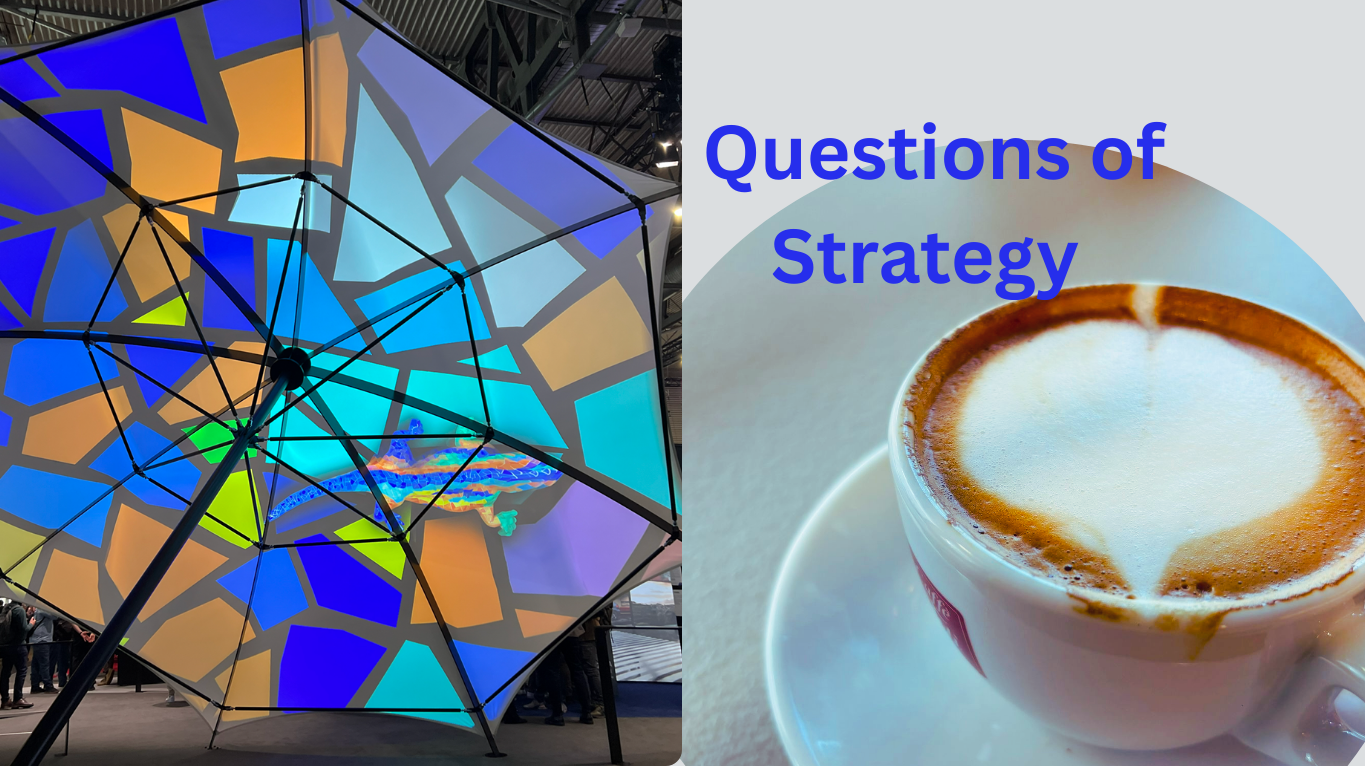
At Integrated Systems Europe in Barcelona, we found ourselves holding cappuccinos and espressos rather than rushing between fleeting encounters. There was no time for distraction anyway. There were conversations. Many conversations in several languages. Sometimes all within the same ten minutes. It felt less like a scheduled series of meetings and more like a continuous exchange of perspectives, ambitions and market signals.
Walking through the halls felt, at moments, less like a traditional trade show and more like stepping into a vast American shopping mall: bright, expansive, slightly overwhelming in scale. With 92,000 visitors, the energy was unmistakable. It reminded us of the NAB Show in its 100,000-visitor heyday many years ago, when sheer scale itself became part of the narrative and attendance numbers were themselves a statement of industry confidence.
What struck us most, however, was not just the number. It was the evolution.
ISE was born as a ProAV show. We remember the early, almost cautious attempts to embrace broadcast. There was curiosity, but also a sense of parallel worlds coexisting, each with their own vocabulary and traditions. Today, that hesitation has disappeared. Broadcast is no longer an invited guest; it is structurally embedded. The combination has matured into a solid and credible convergence. The boundaries between ProAV, broadcast, IP production, enterprise media and live environments are no longer separate territories. They form one ecosystem shaped by shared infrastructures, software-defined workflows and common expectations around flexibility and scalability.
We also saw this convergence reflected in our own work. Several of our customers were debuting at ISE, and for the first time they were able to showcase concrete case studies across esports, IT-driven infrastructures and worship environments, alongside more traditionally AV-oriented spaces. The shift was tangible: from product positioning to demonstrated deployments, from promise to proof. Instead of explaining what their technology could theoretically enable, they were presenting operational realities. The diversity of applications confirmed that these markets are no longer peripheral extensions but central pillars of the same evolving landscape.
In many ways, ISE now feels as though it has absorbed part of what once defined IBC. The centre of gravity appears to be shifting within Europe’s trade show calendar. And with security technologies added this year to the show, another adjacent market is clearly entering the conversation. The ecosystem is expanding both vertically and horizontally, reflecting how media, IT, infrastructure and security are becoming increasingly interdependent.
From our perspective at Xpresso, this is a positive and healthy evolution. It reflects the convergence we have been writing about for years: technology stacks merging, audiences overlapping, disciplines integrating. Yet growth inevitably raises strategic questions. Expansion in square metres and visitor numbers is one dimension. Expansion in vision, positioning and long-term differentiation is another.
What is the long-term strategic direction? Is this organic evolution, or are we witnessing a gradual reconfiguration of the European (or even global) trade show landscape? Could there be a deeper alignment, even a potential annexation, between ISE, IBC and other major industry gatherings? Or will each maintain its own gravitational pull within an increasingly shared universe?
Barcelona offered scale, energy and multilingual dialogue. Now we are curious to hear the broader vision behind the momentum and how this expansion translates into a clearly articulated strategy for the years ahead.