
The Art of Instability: Finding the balance between smoothness, authenticity and immersion
There is a persistent assumption in sports broadcasting that smoothness is synonymous with quality. The logic seems straightforward: if we can eliminate every jolt, every vibration, every trace of camera shake, the viewer will be more comfortable and more immersed. But is it possible to have too much of a good thing?
Certainly, an unstabilised shot feels jarring and disorientating, even though it isn’t experiencing any more motion than we would if we were moving through the scene in person. That’s because human bodies and brains carry an immense amount of inbuilt stabilisation.
But our ability to stabilise isn’t perfect. Which means that our experience of the world comes with a few knocks and bashes, a little bit of shake. Absolute smoothness can – in certain contexts – feel a little jarring.
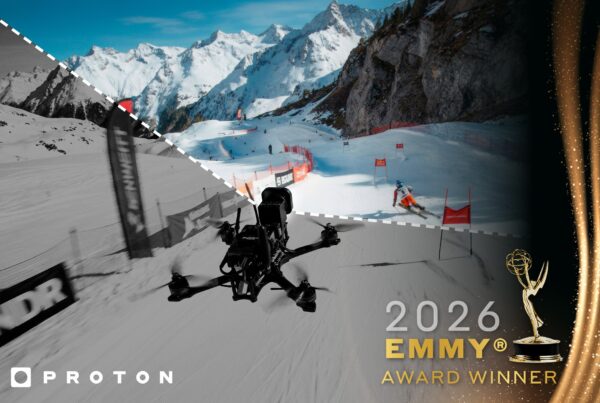
What matters is context. When a downhill skier carves through a course at 80 miles per hour, the viewer wants to feel that speed, that commitment, that exercise of utter control that’s an edge away from chaos – the feeling that they might almost be flying. For that, a buttery smooth shot is actually what’s called for.
But in motorsport, the bumps, the vibrations, the sheer physicality of the machine – these are not defects to be eliminated; they are the story. A rally car thundering through a forest stage communicates its speed through the jolts and judders of the chassis. Remove those, and you remove the thrill. But they need to be rounded out enough that the image can still be processed by the viewer clearly.
So already, it can be seen that stabilisation is a critical creative decision rather than a default max setting.
But then there are the practical realities. Traditional physics-based stabilisation systems – gimbals, gyros, mechanical dampers – simply cannot fit into the spaces where the most compelling sports images are now captured. Net cams, helmet mounts, drone undercarriages: these are environments where every gram counts and every millimetre matters. And even if you can shrink the stabilisation hardware sufficiently, there is the question of durability. Mounting a sophisticated stabilisation system on the bumper of a stock car or an off-road racer that will almost certainly see significant damage during the race is not merely impractical; it is economically unviable.
These are the questions that have shaped PROTON’s approach to camera development. We have developed a range of miniature broadcast cameras, each optimised for different deployment contexts, so that creative teams can choose a tool that matches both their artistic vision and the practical logistics of their production. Whether it is the choice of high frame rate, zoom functionality, mounting flexibility in which the lens is separated by wire from the main body, the need for hard-shell waterproof casing, or a choice between rolling and 1/3 global shutters (with a global shutter already able to eliminate a large amount of instability in a shot), the common theme is that PROTON cameras are miniature enough to go anywhere – with our flagship measuring no bigger than a pair of dice. With our development philosophy, we have a solution for just about every application. And there’s a good chance that if it doesn’t exist, we’re going to build it soon.
In recent years, these cameras have made their way almost everywhere in the world of sport (well, nearly everywhere: whilst this years’ World Cup referee cams weren’t PROTON issued, you could certainly spot our products in lots of other places behind-the-scenes. Or then again, perhaps not – they’re far too tiny to see!).
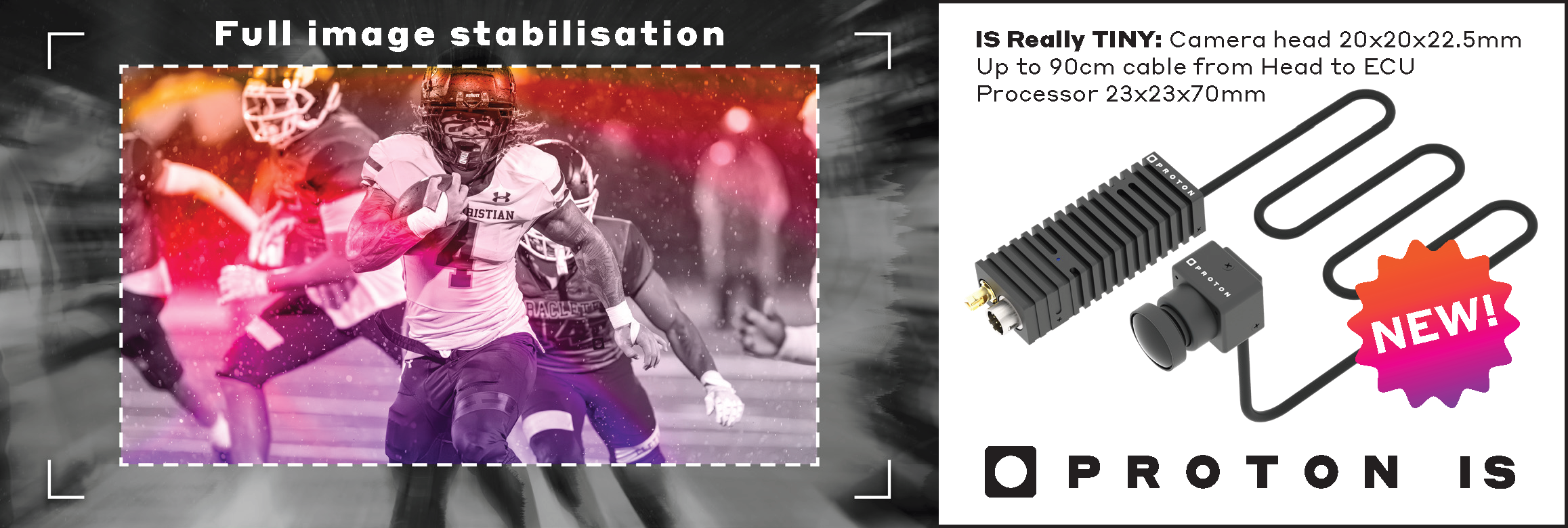
And now, we’ve taken it even further. We’ve developed the PROTON IS (Image Stabilisation), which using cropping and smoothing algorithms to deliver slick, smooth action. Crucially, it also separates the image processor and power supply from the lens – meaning the expensive, sensitive guts of the system can be hidden away in a safe location, while the lens and image sensor itself remains tiny and resilient. It is stabilisation designed for the real world: effective enough to smooth the image, but not so aggressive that it destroys the sensation of speed and impact. And robust enough to survive the environments where it will actually be deployed.
Because ultimately, the goal is not perfection. It is immersion. And immersion requires a careful balance between stability and roughness, between clarity and authenticity. The smoothest image is not always the best. But neither is the rawest. The art lies in knowing the difference.