The Six Essential Questions of Broadcast Audio Engineering
Trackside troubles: the real work of audio engineering
In the world of F1, whilst it’s the drivers who get the headlines, everyone knows it’s a team sport. A similar thing goes on in the world of broadcast – it takes a crew. So if broadcast software developers are the aerodynamicists and engineers – modelling airflow, pouring over telemetry, building a sleek chassis in ideal conditions, then audio engineers would be the pit crew, working in the pit lane, in the rain, with seconds to spare and no room for error. Their role is practical, hands-on, and essential. But it’s also strategic. With every pit stop they must adapt to the conditions and nature of the race. Six fundamental questions frame what they do: What? Where? When? Who? Why? How?
That same practical mindset informs the way Bridge Technologies approaches audio in its production probes. Not as a checklist of features, but as a set of answers to the questions engineers actually ask. Questions rooted in purpose and context. Questions about what happens when something goes wrong at 3am on a live broadcast and there is no time to consult a manual.
What?
The ‘what’ question is twofold: what do audio engineers need to do, and what tools do they need to do it?
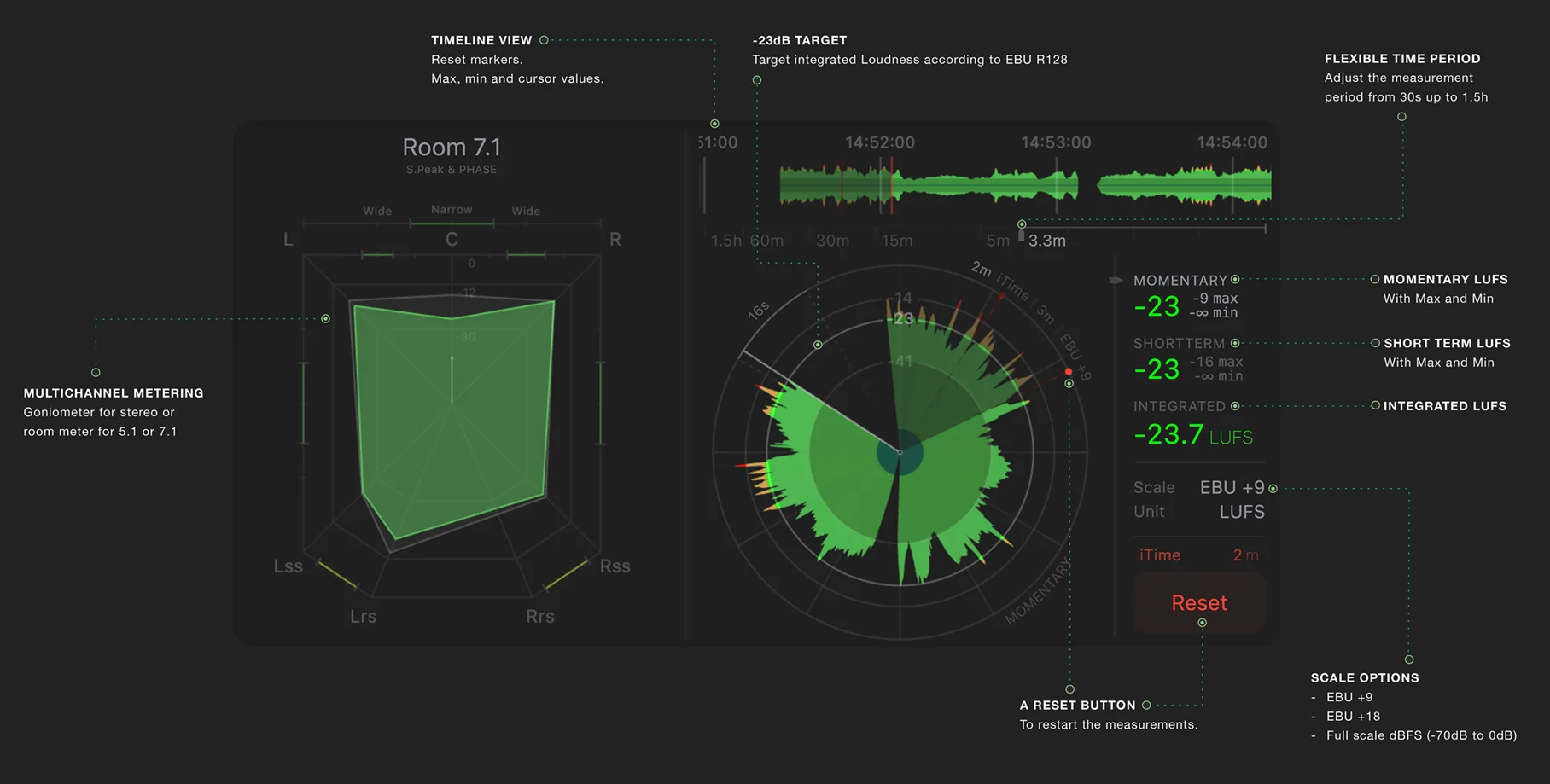
First, if not foremost, audio must balance loudness across a programme so that dialogue, music, and effects sit in the right relationship to one another. For that, the VB440 incorporates loudness metering, phase displays, channel isolation, room metres and support for all Dolby® standards – including Atmos – with visibility across 64 channels per flow, across a virtually unlimited number of flows.
Next, engineers must verify that the correct language commentary accompanies the correct feed, and that it syncs up – not just with video but with subtitles too. This is a not-so-easy task in environments where a single service carries multiple audio channels in multiple languages. As well as single-channel isolation listening for language confirmation (assuming your audio engineer recognises the language!), there is also AVA Sync monitoring (Audio, Video, Ancillary), which measures alignment at the content level using embedded markers rather than relying on packet timestamps, ensuring that audio, video, and ancillary data remain subframe-accurate across the chain.
And when something goes wrong, audio engineers must isolate the problem quickly – often while the broadcast is still on air. For that, the VB440 offers deep real-time network monitoring, including packet capture, PTP timing analysis, and RTP flow inspection, so engineers can determine whether an issue originates in the audio essence itself, the network transporting it, or a device further downstream. This is paired with an intuitive interface and a personalised Canvas workspace that puts the tools each engineer needs front and centre, with next-to-no latency, so decisions can be made in the moment rather than after the fact.
Where?
The quick answer? Anywhere. And nowhere.
The key idea that underpins the VB440 is that through the magic of IP-based production, a user can be on site, in a control room, or in a spare bedroom three thousand miles away – and still access the same tools, the same streams, the same latency-free visibility. That doesn’t just go for audio – the VB440 incorporates tools that span the needs of camera painters, network engineers and producers alike.
But what of audio engineers? What if they’re working in a space that’s cramped and temporary? Access through any HTML5 browser and full-channel-to-stereo downmixes mean you can plonk your audio engineer in the corner and they still have access to every tool they need to perform their job. They might grumble, but…
Or perhaps they’re halfway across the globe, in a dedicated multi-speaker listening room. With the VB440’s direct IP speaker control, audio engineers can engage in immersive listening without the need for intermediary equipment, and – through PoE – without cable clutter either.
Geographically, this all goes beyond ‘mere’ remote production. Temporary events, stadiums, pop-up studios, venues without established audio monitoring rooms, enterprise offices; anywhere where the ability to bring the tools via browser rather than bringing the hardware is practically transformative. It’s not remote production, it’s displaced production.
When?
Before. During. After.
Audio needs to be precise, in the moment, every moment. But achieving that is not just a matter of responding instantly – though with next-to-no latency, that’s exactly what the VB440 facilitates. Instead, it’s about setting a reliable, verified base. With the VB440’s audio signal generation – generating up to 64 channels of audio in any format, grouping and combination of Blits and Glits test signals or static tones – engineers can generate test signals to set up and validate an audio chain on site without rolling out additional kit.
And if things go wrong? The extensive network monitoring metrics of the VB440 incorporates both error and event logging of up to 2000 events, extending back as many as four days providing plenty of data points from which to gain real understanding of what happened, and why.
Who?
Everyone.
The VB440’s audio tools are built with audio engineers in mind: best-in-class tools which would normally take up many dozens of units of rack space. But the VB440 as a whole is designed with accessibility in mind: making data intuitive and usable even to those without deep technical knowledge. For instance, ‘Explanatory Hovercards’ allow a user to hover over any metric and understand how it’s calculated and why it matters.
All of this is available to up to eight users simultaneously, accessed from anywhere in the world. And that’s only the appliance version. With software-only deployments and spin-up services available on cloud-native environments such as NEP Platform and Grass Valley’s AMPP, capacity becomes virtually unlimited and entirely flexible, making it useful all the way from niche broadcasters to Tier One global productions.
Why and How?
Perhaps the easiest questions to answer. Why? Because good audio matters. Study after study show that audio disruption is the first thing that will cause an audience to turn off. And how? Through a deep understanding of IP packet behaviour, built over 20 years, and a vision for a production future which leverages all of the immense potential and possibility of IP.