Why compressed video monitoring is becoming essential for broadband operators
As seen in SCTE Broadband September
By Simen K. Frostad, Chairman of Bridge Technologies
During SCTE’s February ‘SCTE Presents’ show, which focused on Test and Measurement, a sobering narrative emerged from multiple sessions: the struggles of altnets (alternative network providers) and the growing complexity of who owns which layer of the network. Speaker after speaker described the same phenomenon – handoffs between infrastructure owners, wholesale providers, and retail ISPs creating fault zones where responsibility blurs and finger-pointing flourishes. Yet for the subscriber, this complexity is invisible and irrelevant. They paid for fast, reliable internet. When it fails, they blame the only name on their bill.
But the infrastructure layer is but one piece of the pie, and video delivery has the potential to create a convoluted recipe, with the same dynamic playing out at the application layer in even more complex permutations. For broadband operators who increasingly double as video service providers, the stakes are identical – but the finger-pointing has multiplied.
The Video Delivery Finger-Point Paradox
Consider a typical streaming failure scenario. A subscriber in London tries to watch Football on a major streaming service – and they’ve paid a fair bit for the pleasure. The picture freezes, then buffers, then drops to pixelated chaos. The cheers from the neighbours’ house as the match-winning goal is scored, act as particular salt to the wound. Who does the subscriber blame? Perhaps their broadband provider. Perhaps the streaming service. Both names appear on separate bills. Both get equal shares of frustration.
Behind the scenes, the reality is exponentially more complex. The content originated with a league broadcaster, passed through a production facility, was encoded by a vendor, packaged by a CDN, traversed multiple transit providers, entered the broadband operator’s network, crossed the last mile, and finally encountered the subscriber’s home Wi-Fi and device. Any of these handoffs could have introduced the corruption. All of them have stakeholders with vested interests in deflecting blame.
This is the altnet problem, elevated to the application layer. And it demands the same solution: objective, verifiable monitoring at the points of handoff.
The Compressed Monitoring Imperative
Bridge Technologies’ compressed monitoring probes exist precisely for this problem. They don’t care about cable gauges or amplifier specifications. They care about what emerges from the pipe – the actual video and audio streams that determine whether subscribers stay happy or churn.
Three probes form the core of this capability, each serving a particular function in the video delivery chain. The VB120 is Bridge’s monitoring workhorse focused on coverage and reach, the probe you deploy widely across your network to keep eyes on everything at once. It’s designed to monitor streaming services (up to 50 OTT/ABR streams) plus traditional broadcast channels simultaneously, handling both IP and RF inputs via modular interfaces. One unit in a cable headend can verify the quality of everything entering and leaving that location.
The VB220 high-density probe (hardware or software based), lives at the demarcation lines where responsibility shifts between operators, its modular design accepting whatever signal format shows up – satellite, terrestrial, cable, legacy transport, or IP. A single VB220 can monitor up to 260 IP multicasts as found in broadband fiber and cable-TV systems.
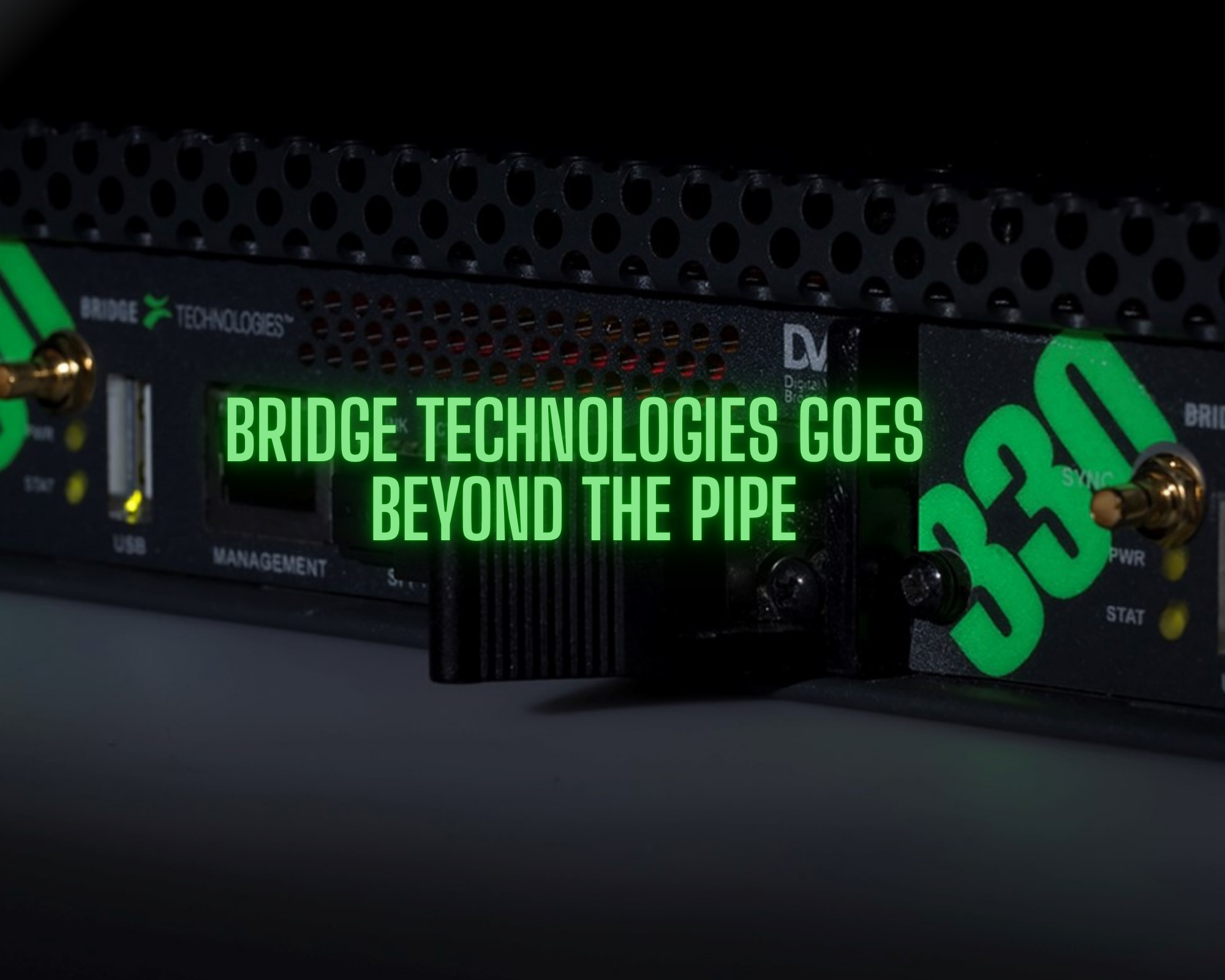
And finally there’s the VB330: a deeper analytical tool focused on insight and diagnosis. It’s what you turn to when something goes wrong and you need to understand exactly why. It can monitor thousands of streams across backbone networks, but its real value is in the depth of analysis: continuous thumbnail decoding to verify actual content, visual evidence of SCTE-35 ad insertions, freeze frame detection, audio level monitoring, and MOS scoring for QoE.
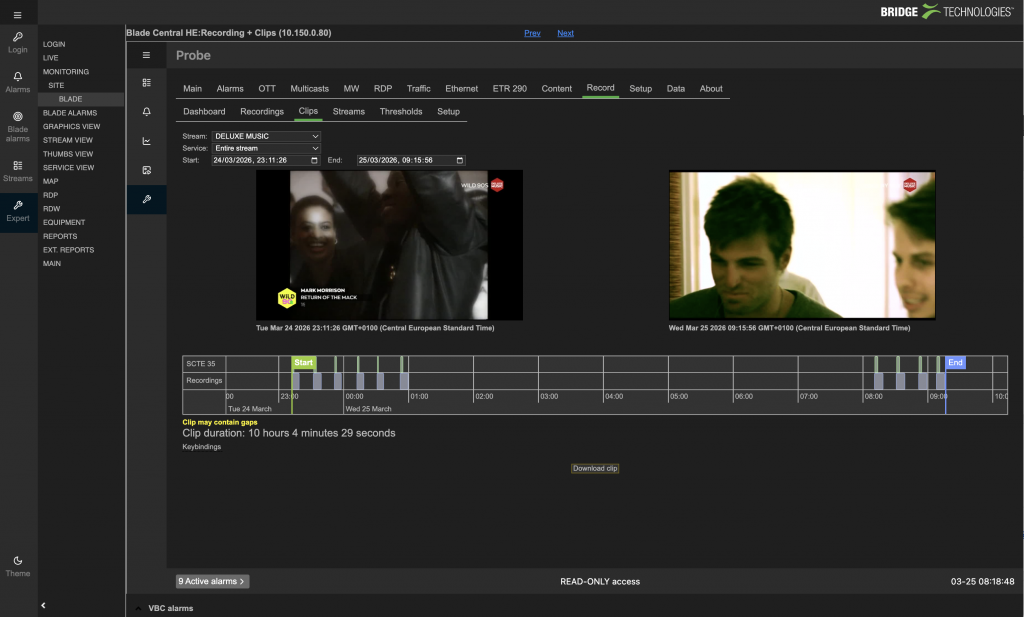
With the full breadth and depth of the broadcast chain covered by these probes, Bridge can provide for any infrastructure of any composition, deploying products from their core range in isolation or combination as needed. And with the VBC, server and element manager, users are able to unify the intelligence gathered from multi-probe setups in a single location – checking the health of every stream at every point in the network – accessible from any browser, anywhere in the world.
For the operator managing complex handoffs, this is transformative. When a content partner claims the issue is your network, you can show them the packet capture from your ingress probe – proving the corruption arrived before your responsibility began. When your own engineering team blames the last mile, you can show them the egress probe data – proving the stream left your headend pristine. The finger-pointing stops. The fixing begins.
The Customer Isn’t Always the Viewer
There’s another dimension to this accountability challenge. In the complex ecosystem of video delivery, the end viewer isn’t necessarily your customer. Sometimes your customer is a content owner who pays you to distribute their streams. Sometimes it’s an advertising agency paying for guaranteed ad impressions. Sometimes it’s a streaming platform paying for reliable delivery to their subscribers.
These stakeholders all have vested interests. And when something goes wrong, they all have reason to point fingers too.
This is where features like SCTE-35 monitoring move from a mere technical capability to fundamental business necessity. Consider a FAST channel operator paying for ad insertions that never actually reached viewers. Without verification, you’re left with he-said-she-said disputes that erode trust and delay payment. With Bridge probes capturing SCTE-35 cues and visually logging the resulting ad insertions, you have objective proof of contractual fulfilment.
The VB330 can monitor SCTE-35 cue in/cue out events in real-time, trigger recording based on those markers, and store visual evidence of exactly what the viewer saw. When an advertiser questions whether their spot actually ran, you don’t need a meeting – you need a screenshot.
This goes far beyond mere ‘compliance theatre’. It’s operational reality in a world where video delivery involves multiple commercial stakeholders, each with legitimate interests in verifying performance. Bridge probes provide the shared truth that lets everyone stop arguing and start collaborating.
From Finger-Pointing to Fixing
The altnet conversation at the SCTE Measuring Event concluded with an uncomfortable but readily apparent truth: subscribers don’t care about your operational complexity. They care about whether their service works. The operator who spends less time managing disputes and more time resolving issues wins.
The same truth applies to video delivery. Every minute your team spends arguing about whose fault a freeze-frame was, is a minute the subscriber spends getting frustrated. Every hour your commercial team spends negotiating ad-insertion disputes is an hour your competitors spend winning new business.
Bridge Technologies’ compressed monitoring probes don’t just measure video quality. They create a shared reality across handoffs, a single source of truth that eliminates ambiguity. The VBC extends that truth across your entire footprint, accessible anywhere, understood instantly. By the time the stream reaches the viewer, the issues have been found and fixed – not debated and deferred.
The viewer has no finger to point. And that, ultimately, is the only metric that matters.