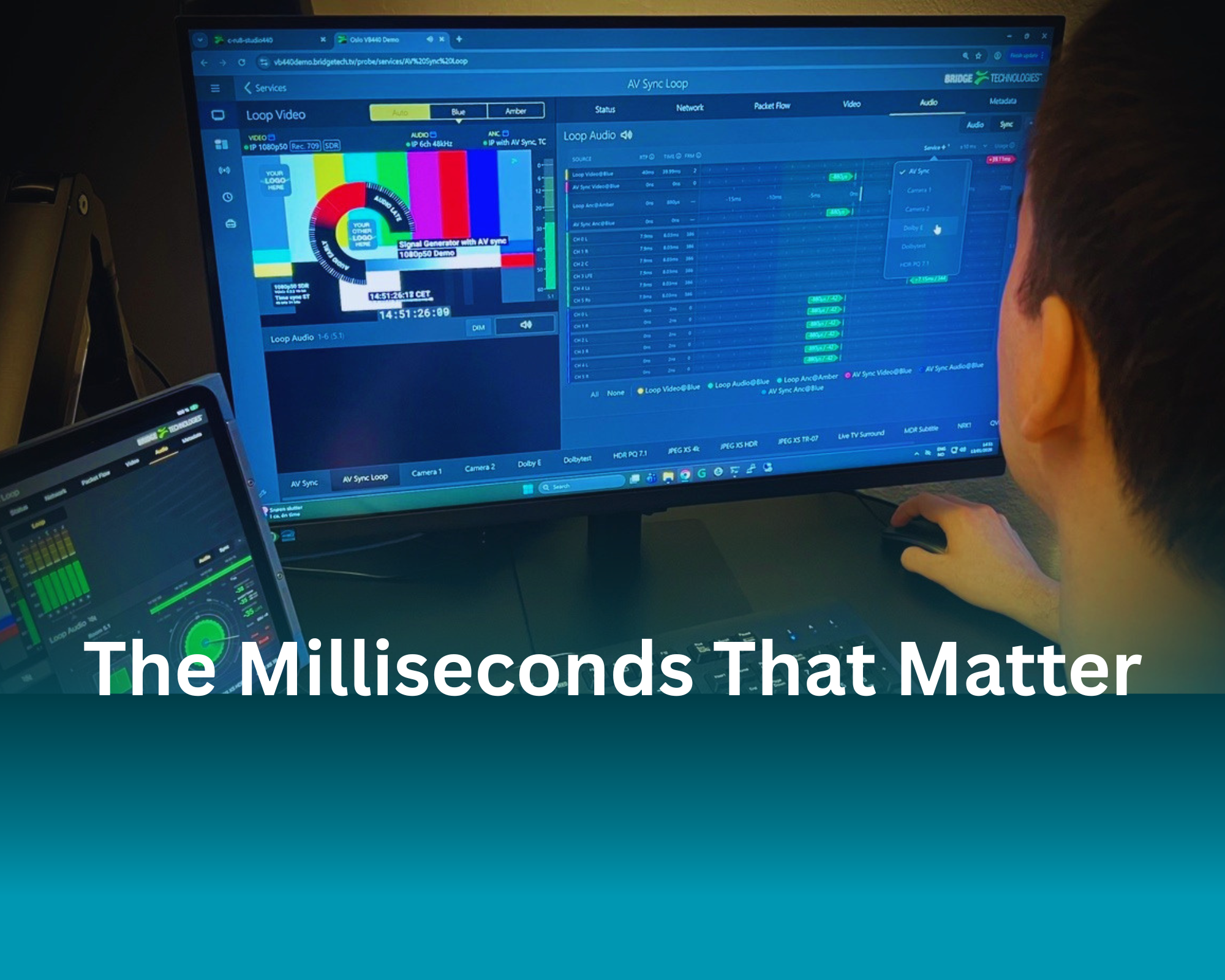

How Bridge Technologies help broadcasters bring audio, video and ancillary data back into perfect alignment
The Sync That Time Forgot
The issue of AV sync is – to coin the title of a famous Disney song – genuinely a ‘Tale as Old as Time’. Unlike cinema, which started with silent movies and introduced audio in the late 1920s, television had audio from its earliest days. But TV inherited much of its infrastructure from radio, with early BBC engineers effectively monitoring early BBC transmissions by watching a low-resolution video signal whilst listening to a separate radio audio feed, and then manually adjusting for timing differences.
Of course, the 1920s are a hundred years ago. We’ve surely come a long way since then?
Well, yes. But not as much as you might think.
The Hidden Sync Challenge
IP has made broadcast production and distribution better; there can be no doubt there. But it did have to make a few things more complicated in order to make them easy. AV and ancillary sync are one of those things.
In SDI, synchronisation was largely inherent. A single serial stream carried active video, embedded audio, and ancillary data – subtitles, timecode, SCTE-104 triggers, HDR metadata – all locked together in the video raster. If the video arrived, everything arrived with it.
ST 2110 changed that. Video (-20), audio (-30), and ancillary data (-40) are now independent essence flows. They not only traverse different multicast groups and network paths, but they can have significantly different processing delays (as much as 120ms, 105ms and 95ms respectively). Ultimately, PTP provides a common clock, but it does not guarantee equal processing latency through the media chain.
Not all sync issues are created equal
Our brains are – not all that surprisingly when you think about it – conditioned to see something before we expect to hear it. After all, sound travels more slowly than light, and the human brain is conditioned by physics. So, whilst it’s not too jarring to see someone kick and ball and then hear a solid ‘thwack’ a moment later, the opposite is quite disconcerting. As such, industry guidelines recommend that audio leading video should not exceed 20-40 milliseconds, while audio lagging video can extend to 40-60 milliseconds before becoming noticeable.
Content also matters. News, interviews, emotional dramas or anybody singing will reveal sync errors as low as 20-30 milliseconds, while there is a much higher tolerance for high-paced action, nature documentaries and crowd shots (80ms or more).
And – as is so often the case in broadcast – sport comes with its own set of considerations. There may be crowds and the action may be at a distance, but viewers are highly sensitive to commentary-action sync, referee decisions and goal celebrations: anything that hinges on the split-second action being seen and felt at exactly the right moment.
Ultimately, as is always the case in technology, understanding the psychology of the viewer – cognitive and emotional – is just as important as understanding the underpinning technology.
Subtitles Have Entered the Chat
As if things weren’t already challenging enough, there’s also the third ‘-40’ data flow to contend with – ancillary data. And it matters more than ever. For decades, sync meant lip-sync between audio and video. Get those two aligned and you were done. But the world has changed. Subtitles are no longer a niche accessibility feature for a small audience. They are mainstream.
According to a 2024 survey by Verizon Media and YouGov, 80% of people aged 18-25 use subtitles ‘all or some of the time’. In a separate study, over half of US adults who use subtitles said they do so not for hearing reasons, but to avoid missing dialogue due to poor audio mixing, distracting background music, or simply the habit of watching content on phones in noisy environments. The reasons are varied – quiet dialogue, thick accents, watching in public places, or just the creeping realisation that modern audio mixing sometimes prioritises explosions over intelligibility.
Subtitles are everywhere. And when subtitles are out of sync, it is not a minor irritation: it is a viewer experience disaster. A subtitle that rushes ahead spoils a punchline. One that lags behind undermines comprehension. And for sport? Nobody wants to read ‘goooooooaaaal’ three seconds before the ball has blasted into the net – it entirely destroys the suspense and excitement.
Why this all matters – but particularly ANC data
Of course, the main reason it matters is viewer experience. A frustrated customer is a customer who will quickly change the channel. Or the stream. And in time, maybe even their subscription – if the frustrations persist for long enough.
However, it’s important to recognise that those frustrations take multiple forms. We’ve already discussed the obvious – lips and text that don’t match what’s seen and heard on the screen. But the implications for misaligned ANC data extend further. Take HDR metadata, where incorrect alignment can lead to visible picture artefacts or inappropriate luminance mapping. Or SCTE-104 trigger messages, which may trigger mid-sentence when ANC data is misaligned. That’s not just an annoyed viewer, that’s an annoyed revenue source – and that’s a real problem.
What’s to be done
The fact that the PTP alone isn’t enough to manage AV sync is why Bridge’s solution to AV and ANC sync is so important. It constitutes a ‘first line of defence’ that doesn’t simply rely on packet timing, but actually embeds physical, machine-readable markers that can be used to bring the synchronisation back when needed. And most crucially, it doesn’t just do this for audio and video streams, but for those vital ANC -40 streams too*.
Ultimately, for broadcasters who understand that sound, subtitles and sync are unbreakable bedfellows when it comes to viewer experience, there can be no more important tool than the VB440.
*There’s also some very clever stuff in the VB440 which allows this sync to be measured not just within a combined -20-30-40 broadcast, but across multiple versions of the same combined flow, received from different redundancy sources, in order to manage frame-perfect source switching sync during live productions. But that’s an issue for a whole other blog.