
VBC Live evolves from coordination tool to monitoring hub
Broadcasters and media companies are being asked to do something that should not, on paper, be possible. Networks grow more complex by the month. Traffic multiplies. Hybrid cloud and on-premises infrastructures layer upon one another. And yet the operational instruction remains the same: do it all with less.
How, though? The answer lies, as it always has, lies in efficiency. But efficiency is often a grossly misunderstood word. Efficiency is not simply reducing resources whilst demanding higher outputs. It’s not simply a case of ‘work harder’. It’s more a case of ‘think differently’. Examine systems from the top down and the bottom up, and understand truly where resources are slipping out through the gaps.
Mind the gap(s)
One of the greatest inefficiencies in broadcast systems is the presence of multiple vendors, systems and technologies, the need to train individuals on each specifically, and the need to have them switch between systems repeatedly over the course of a working day. This is particularly true in the field of broadcast monitoring, where there are multiple elements of the broadcast chain – from live acquisition and production, through transmission infrastructure, to the viewer’s screen, each generating its own data and its own alarms. Monitoring systems cross a variety of technologies and deliver back complex, granular detail that can be meaningless if not understood properly. And that can be a real problem: the last thing a broadcast operation needs is its lead technical engineer running around like a headless chicken, not just within the central facility itself, but across disparate geographical sites, fighting fires and explaining complex technical data to the uninitiated.
What is needed is one system to log into. One browser to do it from. One centralised location that is, paradoxically, located nowhere in particular: available for the engineer to use on-the-go, in real-time, across their full end-to-end broadcast chain, from anywhere in the world. And even more, what is needed is an intuitive interface and visualisation that means anyone can take meaning from the data. That means not just the increasingly thinly-stretched lead network engineer, but anybody in the facility who needs to know what is happening, and fast.
It isn’t about dumbing down. The underlying complexity remains. Networks must still be monitored at granular level, with deep-dive capability for when things go wrong. The innovation lies in how that complexity is surfaced. Visualisations that make status immediately understandable. Alarming that directs attention where it is needed, not everywhere at once. Interfaces that can be shaped to reflect how different users actually work, rather than forcing them to adapt to a one-size-fits-all dashboard.
Bridging the gap between less and more
It is recognition of these pressures that has driven the recent evolution of Bridge Technologies’ VBC Server and element Manager. What began as a centralised management layer for Bridge network monitoring probes has matured into something more significant. The VBC is no longer simply a convenient addition to a monitoring deployment. With the release of version 7.0, it now sits at the heart of a unified approach to monitoring from end-to-end, aggregating data, visualising service status, and providing a single point of control for operations of any scale.
From coordination tool to monitoring hub
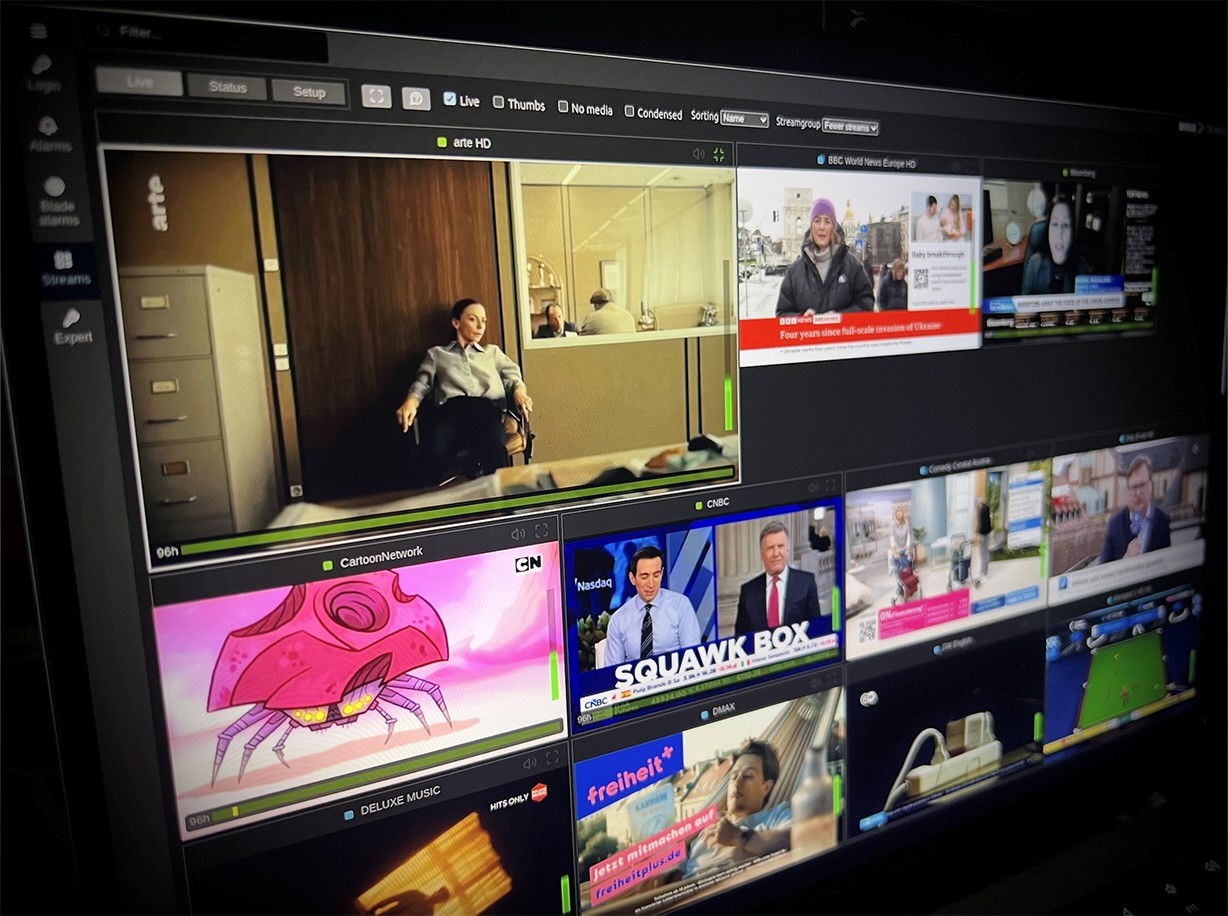
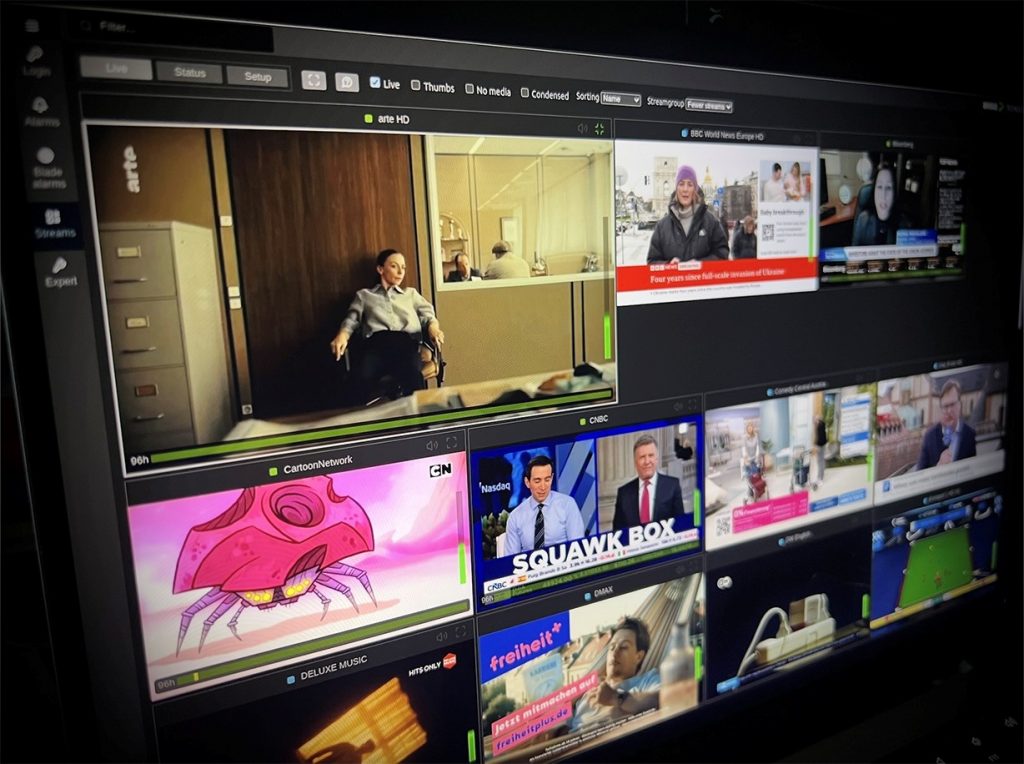
Version 7.0 marks a fundamental shift. For the first time, the VBC evolves from a background coordination tool into a fully featured solution in its own right. It can now present live video and audio directly, opening up entirely new operational use cases alongside its established capabilities in alarm aggregation and system management. Users can, as standard, view up to five live services in a mosaic-style stream, complete with audio bars and audio on/off indicators. However, for users seeking greater scale, there is VBC-LIVE-OPT. This unlocks live viewing beyond five services, with the ultimate capacity only determined by available processing resources, stream type, and resolution.
This expansion is supported by a completely refreshed user interface, designed around clearer navigation, more intuitive data panels, and faster access to the information that matters. The principle is straightforward: if monitoring is to be accessible to a wider range of operational staff, the interface through which they interact with it must be immediately understandable, regardless of whether the user is a senior engineer or a junior operator responding to an alert.
A dedicated future
For Bridge, these developments represent only the start of a new path forward for the VBC. What was once a supporting player in the Bridge portfolio has become a central component in its own right. The logic is straightforward: if monitoring is to become more unified, more intuitive, and more accessible to a wider range of operational staff, then the platform that enables that unification deserves focused attention and continued investment, with its own product development roadmap for the future.
For broadcasters navigating the competing demands of growing complexity and static resources, the path forward depends on tools that can do both: consolidate and clarify, centralise and simplify. The challenge is not going away. But the means of meeting it continues to evolve.