
Marketing Content
Blogs about PR, Marketing and Technology
Why Marketing Communications Can’t Ignore the Personality of Your Business?
Blog
Innovation in technology is rarer than you’d think
What is the mark of ‘good’ technology? Technology that endures, inspires and enriches?
It can be easy to instantly jump to thoughts of the technologies that have resulted in fundamental paradigm change; the development of the combustion engine, the lightbulb, the first personal computer, the internet, revolutionary, and of course, the mobile phone.
But paradigm change – whilst vital for societal progress – is not necessarily the hallmark of what constitutes good technology. Innovation is often seen as the core component of success, but in the field of technology, true innovation – revolutionary, paradigm changing innovation – comes along fairly infrequently. It is instead the incremental evolutions and improvements that put much of what we consider ‘good’ in the hands of the average user.
Take for example the internet. Its conception was undoubtedly remarkable. Revolutionary. But at that initial point – when the message ‘LOGIN’ was sent from UCLA to Stamford – to the average user, the internet carried very little value. None, really. It was inaccessible. Unusable.
It is only through the various tech companies that have applied themselves to its evolution that the internet became something that the average user could make meaningful use of (though whether we can classify the internet as something good that inspires and enriches is, of course, up for debate). None-the-less, the core point still stands: innovation may be an important starting point, but it is both its expansion and refinement that gives us something of value.
And for these technologies to succeed, that refinement generally needs to focus on one point more than any other: alignment with human psychology.
On every level, the value of a technology needs to tie in with an essential humanity; it needs to serve a fundamental human need or desire, and it needs to work in a way that is in tune with human psychology and instinct. At the heart of all those 1s and 0s ultimately lies an actual, beating heart.
Companies in tech might forget the human dimension
The best illustration of the truth of this statement – that it is human psychology which lies at the heart of good technology – is perhaps an example of times when it has gone terribly wrong. How many applications or websites have you rage quit simply because of the utter frustration involved in trying to use them?
It’s interesting to find that actually, some of the biggest names in technology are the ones who are responsible for some of the most egregious failures. Perhaps simply because they have the budgets to make mistakes. A quick trawl of the internet throws up a number of gems.
The BMW i-drive and Apple Watch
The iDrive lasted just a year in BMW models, between 2007 and 2008. 700 functions controlled by one rotating button that could be pressed, knocked or twisted in eight different directions. There is almost literally nothing that could be intuitive about that; it necessarily required users to learn how to make use of it – and nobody has time for that (not least when ideally they should be concentrating on the actual process of driving…).
Interestingly, the Apple watch suffers from a similar fate with its dial based interface (it’s one of the few products Apple were not keen to shout sales figures about from the rooftop…). A case of trying to cram too much into too little.
Windows 8
The less said about this the better. Its adoption levels were atrocious, and Windows were quick to move away from it with Windows 10. As with the BMW/Apple example above, arguably it came from trying to cram too much in (namely, tablet and desktop interfaces together) resulting in something unintuitive. Psychologically, people like to be able to do the main things they need really easily, rather than have the option to perform a multitude of functions in a convoluted way.
Google glass
Google has a back catalogue of products which have fallen by the wayside. Google Glass was perhaps one of the most visible fails the company experienced though.
Its failures stemmed from neglecting to consider fundamental elements of human psychology; notably, the concept of being ‘social’. Now we know that the stereotype these days is of people gazing at their mobile phones and ignoring each other, but the reality of a phone is that other people can tell whether they have your attention or not, and it is possible to engage in a hybrid-type experience where you are engaged with the physical company around you, whilst also browsing for information/chatting online/taking photos. Indeed, many of those processes actually contribute to your direct interactions, as you show information or pictures to a friend, or pass on information you’ve received in an online conversation.
The concept of Google Glass was entirely more personal and insular. How was anybody around you to know whether they had your attention when you had funky glasses on and were staring off into middle distance? Google Glass ignored a fundamental part of human psychology and technological engagement – at its peril.
Engineers are a breed apart…
But these are all B2C tech products, I hear you cry. In our markets, we’re dealing with B2B sales. Putting the technology in the hands of engineers. We don’t need to cater to lowest-common-denominator consumers and their inherent lack of technical expertise, do we?
Well yes, but (and you might be shocked to hear this) engineers are humans too – they like things to be straightforward, intuitive and usable too. Sure, they may have more appetite to ‘learn’ the fundamentals of a technology, and more need for depth of function, but they don’t like things being unnecessarily complicated just for the sake of it. They still have a fundamental psychology that needs to be accommodated in the technologies that are designed for them.
And more than that, increasingly a lot of the processes being undertaken in the broadcast market aren’t completely driven by engineers. A shift in the nature of the industry means that people from different backgrounds, particularly creative and business fields, are stepping into roles previously held by engineers. And they definitely want things to be clear, intuitive and usable.
The key message: technicians, engineers and designers always need to keep their eye on the end game: user need and user experience.
Keeping it human all the way along the chain
So if you are going to pay that much attention to ensuring that the fundamental nature of your technology – the underpinning psychology of its purpose, its GUI, the UX – is all aligned with human psychology, why in the world would you let your marketing and communications revert to a world of technobabble and sterile detail?
Communications and sales need to focus on benefits. Sure, it might be important to explain how that benefit is achieved, but fundamentally customers need to know what human need is being met with your technology; how their customers are going to benefit, how that will give their business the competitive advantage they’re seeking , and how this is all going to result in increased bottom line profits.
And returning to one of the points made at the outset; a lot of the market space in the technology realm is not seeking to achieve sales on the basis of revolutionary innovation. Instead, it’s seeking to win market share on the base of differentiation; small improvements to the nature of the product that make them better for the user. Sometimes these small improvements read pretty insignificantly when listed as technical details – but when put into a proper context through effective communications, their true meaning comes to life.
Ultimately, people sell to people
Moreover, sometimes, that ‘better’ might not come only from the product itself, but from your business. Is doing business with you easier, more enjoyable, supported by greater trust and shared values? This can sway even the most technically-minded of engineers. Even in business, we aren’t always ‘rational consumers’. Not everything is a mathematical equation of pluses and minuses; sometimes we’re swayed by non-tangible elements. If this wasn’t true, why would it be that some sales people are simply better than others? If we were all rational consumers, the product would simply sell itself, right?
This means that, no matter how deeply technical your product is, your marketing and communication can’t afford to ignore the fundamental personality of your business, and the people within it.
At Xpresso, we understand technical detail, but far more than that, we understand(at least we try to) and are interested in people. So if you’ve invested resources in understanding the psychology of technology as much as you understand the 0s and the 1s, then maybe it’s time to invest that same insight in your marketing and communications.
How to keep the Monkey Brain at bay in business
Stop Monkeying around, there’s work to be done
BLOG
Monkey business
Monkeys get a hard time of it in psychological literature. ‘Monkey brain’ is used to refer to a great number of our most base, most simplistic models of thought. Anybody who employs the phrase ‘Monkey Brain’ is rarely referring to our best selves.
For instance, Diana Raab, (2017) inspired by writer and Buddhist Natalie Goldberg, identifies that the Buddhists referred to ‘Monkey Brain’ as the zone one falls into when they feel restless, unsettled and confused. An anxious state where nothing sits well. She forwards the idea that Monkey Brain is hugely interconnected with ego; introspective, critical, full of thoughts focused on the self and how it is being perceived. This isn’t the ‘arrogant’ ego that people think of when they hear the word; it’s just as self-involved, but it’s highly critical: second guessing every judgement, lacking decisiveness.
It’s the Monkey Brain that is easily distracted, precisely because it is scared of addressing complex decisions. It’s over-thinking to the point of inaction.
Which is interesting, because other interpretations of the idea of ‘Monkey Brain’ express almost the exact opposite. Wood and Petriglieri (2005) frame Monkey Brain as a process of relying heavily on binary mechanisms to make snap decisions. It is the simplistic process of not thinking deeply about things. It’s about filtering out complexity and turning things into basic considerations of ‘good’ and ‘bad’, ‘right’ and ‘wrong’.
We see it all over the place: politics, morality, and, of course, business. We filter out what feels like extraneous ‘noise’ in the decision making process in order to give us confidence in our decisions. When we eliminate detail, we eliminate doubt. But that isn’t always for the best…
The truth is – both ‘types’ of Monkey Brain boil down to the same thing: nuance is complex, mentally hard and cognitively taxing. And because it’s hard, we tend to take one of two Monkey approaches: avoidance (as Raab suggests), or over-simplification (as Wood and Petriglieri frame it).
And no doubt, these psychological devices have their place. Once upon a time – back in the days of caves, hunting and gathering – they may even have been life-saving. Not sure about those berries? Perhaps best to avoid making a decision and wait to gather (excuse the pun) more evidence. Raab’s procrastination and avoidance of decision making is probably a good idea there.
But faced with a saber-toothed tiger that might be a friendly pet, or might be about to savage you? Probably best to make a snap-decision based on simplistic and binary considerations.
Either way, both psychological approaches are about keeping the monkey alive.
Monkeys in the modern world
But modern business isn’t about berry eating or sabre-tooth tigers (well, only in quite niche industries).
The problem is, the harder times get, the easier and more comfortable it feels to regress to our more primitive ways of thinking. And times have rarely been harder than they are now.
Monkey thinking has led many – across practically every industry – to think ‘spending = bad, saving = good’. And one can’t help but understand the Monkey-brained nature of this thinking. It’s elegant in its simplicity – it makes ‘instinctual’ sense. If resources are scarce, preserve them, right? Avoid taking action, making decisions, and spending money.
Certainly, there are areas where this is true. But even in a primitive world, there are circumstances where this simplistic line of reasoning simply doesn’t follow. If you’re starving, you could eek out your remaining berries and survive another four days, barely clinging on. Or you could eat all of your berries and have the energy to go and hunt down a Wooly Mammoth – which will keep you fed for another six months.
There are ultimately times when thinking simplistically and shortsightedly simply won’t cut it. The problem is, the times when we’re most likely to think like this – when we’re scared – are exactly the times when we shouldn’t.
Another Monkey metaphor
So that brings us to another piece of Monkey-thinking we read about recently. X (former Google X) works on the basis of ‘Monkey First’ thinking. That doesn’t mean giving priority to Monkey Thinking. Instead, it means that recognizing that if you want to train a monkey to stand on a pedestal and recite Shakespeare, the first thing you do is start training the Monkey, not building the pedestal.
In essence, find the hard decisions or actions and tackle them. Anybody can build a pedestal, and they can do it in five minutes. But training that Monkey… that’ll take time and effort.
Problem is, when times are hard, people want the satisfaction of instant results and wins. It’s a psychological boost we all crave.
But if you chase that early win, all you’ll end up with is generic pedestal and a misbehaving monkey. And that’s hardly likely to set the markets on fire, is it?
What happens when Monkeys drink coffee
At Xpresso, we’ve always prided ourselves on our efforts to keep the Monkey Brain at bay. Maybe put it down to the powers of caffeine and long walks in nature; they both allow for clear thought and an ability to think through all the angles, but then be decisive when needed (and the key there is decisive, rather than reactionary).
It’s this (we humbly submit) that has kept us going in challenging times. We plan for both ourselves and our clients in a way that takes account of the big picture, and the long-term game. We’re sensitive to the realities of current situations, but not the instinctual fear of them.
Of course, part of the key to this is: no monkey stands alone. They’re actually incredibly social animals. So the key is not to let the individual monkey brain take over, but to rely on the strength of the group; to keep communication and interaction open, to build on each other’s strengths, and adapt to each other’s circumstances. To seek opportunity, reeducation, adaptation (after all, monkeys are some of the very few animals to adopt new tools to adapt to their circumstances). To discuss ideas in a way that finds the balance between proactivity and reactivity. To know when there’s a time for nuance, and when there’s a time for decisiveness.
Monkeys in suits might be cute, but they don’t make for good CEOs.
The history of the coffee break
Coffee is in our name.
Not only is it there to represent the Italian roots of our founder Fiorenza Mella, but it communicates key elements of the service we offer; it talks of something fast, efficient and packed with energy, something intense, something undertaken socially, a practical pleasure.
But we are hardly the only business with which coffee is associated. Indeed, coffee is really a mainstay of the corporate world. The idea of a ‘World’s Best Boss’ coffee mug has become a drippingly ironic take on corporate climbing (helped in no small part by the US series ‘The Office’), whilst gripes about people taking the last of the coffee and not replacing it represents the major frustrations of the minutiae that make up the daily office grind. And if you haven’t watched booths at IBC move from offering a hastily swirled cup of instant Kenco to a fancy Nespresso machine to full blown Barista service, you haven’t been paying attention.
But why is coffee so synonymous with the business environment? What is the history of a workplace coffee break?
The origins of coffee itself are often traced back to the legend of Kenyan goats who seemed imbued with energy after eating from a particular plant (and so came the expression ‘full of beans’). But Kenyan goats aren’t known for taking business meetings.
The idea of the work-place coffee break itself really came around as a result of a confluence of factors occurring at the same time. Industrialisation brought about a more rigidly defined eight hour day, and the opportunity to recharge or rest at midday that was often associated with agricultural work (though the clever Italians and Spanish have still managed to keep a tight grip on their precious lunch breaks – the riposo/siesta). Alongside this, improvements were made in the harvesting and industrial processing of coffee; it became easier, quicker and cheaper to do.
Workers loved the energy jolt that coffee gave them, and employers realized that a small break was actually a boon to overall productivity. Over in the States, organisations such as the ‘Pan-American Coffee Bureau’ sought to push the interests of coffees with heavy promotion, including the slogan ‘Give yourself a Coffee-Break—and Get What Coffee Gives to You’.
Outside of US though, the tradition of a coffee break has been firmly established in a number of cultures. ‘Fika’ in Sweden is far more than just a coffee (not least because it usually also involves a delicious cinnamon and cardamom bun). It is considered an institution, a ritual, and a state of mind – not to mention a right protected by law. But for others, coffee breaks actually manifest quite differently: up until 2014 in Australia that legally protected right was called a ‘smoko’ because it was – as you can guess – far more devoted to a quick cigarette, whilst in the UK, it’s a sure bet that most of the office are drinking tea!
One more Award
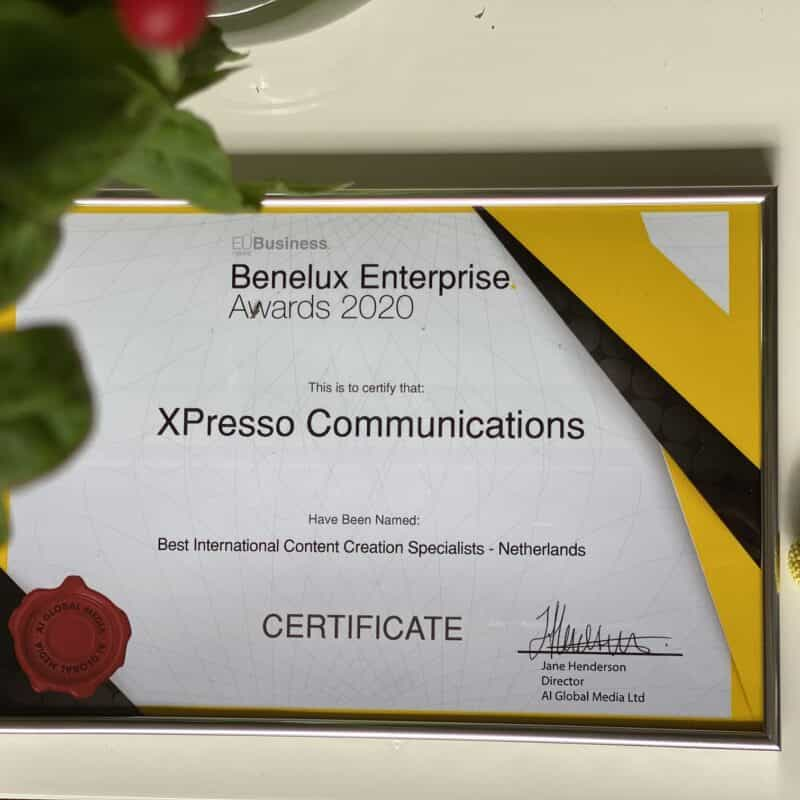
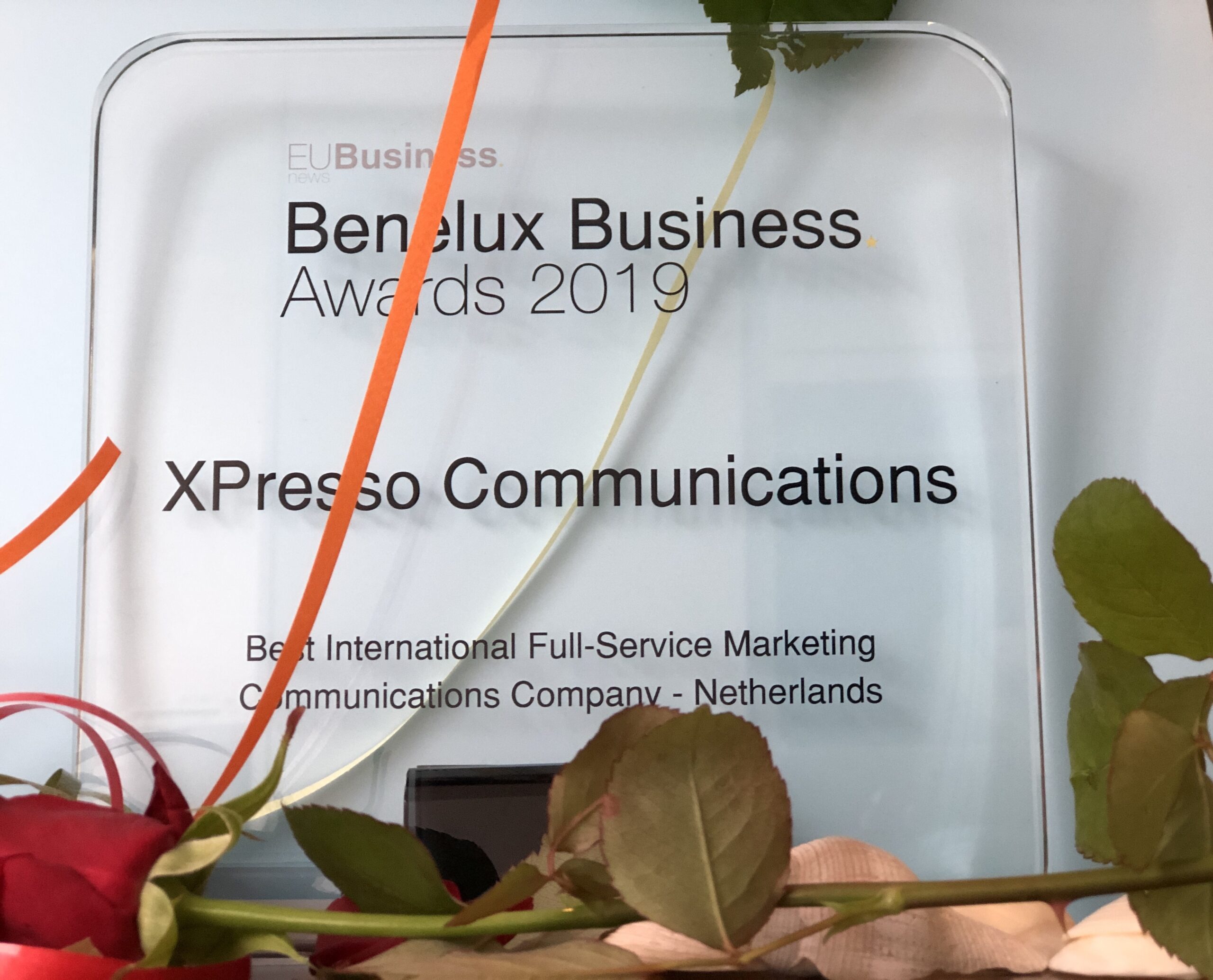
Yes, another reason for a coffee break and more. At the end of September we were awarded the ‘Best International Content Creation Specialists’ , award for companies headquartered in the Benelux region, granted by the EU Business News Awards panel – which independently assesses the business contributions of firms throughout Europe. This is the second year we’ve won such a prestigious accolade, and we honestly couldn’t be more proud. In particular, we were excited to be able to talk about our latest award; because the best coffee breaks with friends are the ones where you can share your achievements.
Investing in coffee
All of this talk of coffee also brings about an interesting analogy that we’ve been mulling on for a while. At the beginning of this article we talked about how employers realized that ‘investing’ in supposedly non-productive time (in the form of a coffee break) actually increased productivity overall. We also talked about how at IBC, the investment in full blown Espresso machines with professionally-trained baristas is now becoming something of a norm. And there’s a commonly held idea that if you’re interviewing at a new workplace, check out the breakroom and their biscuit selection. No biscuits? – not a chance. A few Jammie Dodgers? hmmm OK. A fully stocked kitchen of healthy snacks, refrigerated drinks, good quality coffee, cake (mmm, cake) and beanbags? There you are.
This ‘acid test’ for those scoping out a new workplace is basically about assessing the nature of the company; how much do they invest in their employees, in their reputation, in their integrity? How much do they see that a few short term expenses can engender significant long term benefits?
But when times get tough – is the answer to take away coffee breaks and just make employees work even harder, over longer hours? To start offering instant coffee in old chipped mugs to clients, and take away the sexy Nespresso machine? Almost certainly not. That’s reactionary, short-sighted, panicky behavior that fails to see the root of the problem. Indeed, if anything, tough times are the times to invest the most in your employees and in the impression you give to clients, because if there is anything that is going to set the ship right, it’s that.
So why is it now, when times are tough, some companies are making cuts to their marketing and communications strategies, when now is exactly the time to be investing more in them? When you can’t meet your clients in person, the strength of your comms strategy becomes even more vital than ever.
In essence: when you’re in need of a serious energy boost, now is not the time to be reaching for the jar of instant coffee – it’s time for a super-strength ‘Xpresso’.
Content strategies avoiding entropy in communications
Press Release
Leiden, The Netherlands _ 16 October 2020
Xpresso Communications – an international marketing communications and PR company headquartered in Leiden, The Netherlands – is proud to announce that it has been awarded the title of ‘Best International Content Creation Specialists’ residing in the Benelux region.
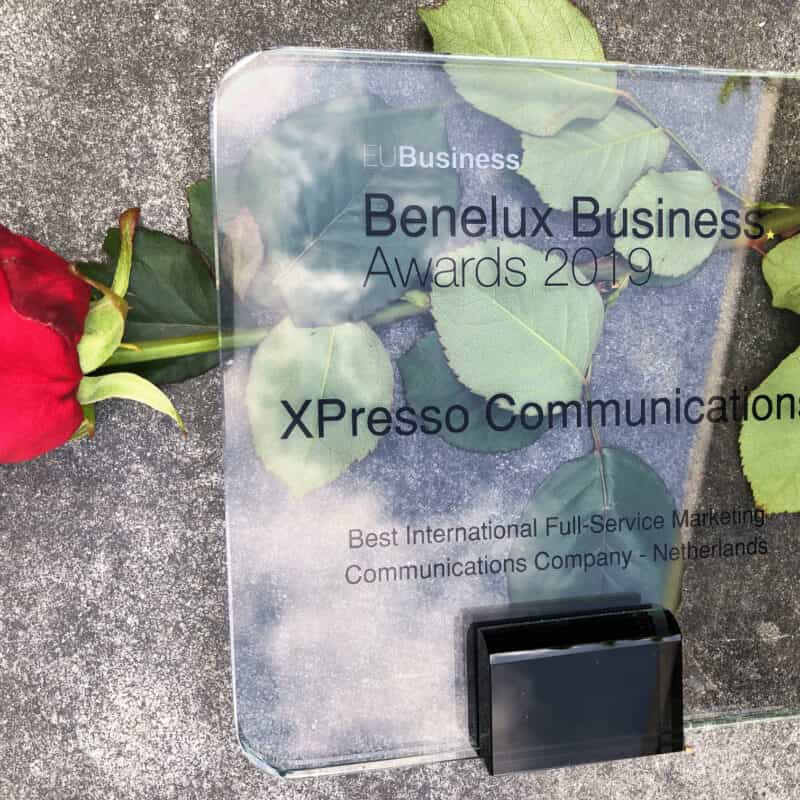
Following its 2019 Benelux Business Awards as ‘Best International Full-Service Marketing Communications Company’ in The Netherlands, Xpresso Communications received a second award in recognition of the excellence it has achieved in the field of content creation as part of its integrated communications, PR and marketing strategies for technology-driven companies.
“At EU Business News, our award programme makes sure every company is thoroughly researched, meaning that our awards are only given based on merit and not how many votes have been received,” explained Laura Hunter, Awards Manager, EU Business News. “We investigate many different fields when judging a company, such as dedication to customer service and the excellence and innovation that the company brings to its industry.”
Representing technology firms around the world in the field of broadcast, proAV and numerous other technology-driven markets, Xpresso Communications maintains a team of international content strategists and creators who excel in writing and distributing content that engages with the human aspect of business, whilst also demonstrating a deep understanding of underlying technologies. This vision of creating and delivering technology content for a broader audience, including – but not limited to – those who are less tech-savvy, is based on the idea of focusing on the benefits of a given solution, rather than its technical specification. This itself constitutes a key point of differentiation from many other companies in the media and technology industries, and it is this which CEO Fiorenza Mella believes was key in contributing to Xpresso’s nomination and eventual win.
“My team and I are honoured and amazed by this unexpected award, the second in as many years” said Mella. “The Benelux Enterprise Awards panel initially explored our role as leaders of PR and marketing practices within technology-driven markets. This year, however, they have recognised our increasing relevance as innovative content providers and strategists. We believe that a large part of why we were chosen relates to the way that we have aimed to make technology-orientated communications more accessible, relevant and ‘human’ in nature. This is enhanced by our industry expertise, and evidenced by how we have supported the international launch of several business in niche markets, including that of the Broadcast industry. Also important, we believe, was how we promote content distribution through online integrated marketing strategies.”
Xpresso prides itself not only on the company’s ability to make detail-heavy technology products accessible to non-technical decision makers and to foster genuine connections between clients and customers, but also to deliver real strategic advantage by making the process of outsourcing communications truly efficient.
“A key consideration in our communications approach is the idea of entropy. As things lose energy, a ‘descent’ into disorder tends to occur, and at that point it can be difficult to reinvigorate a message with energy and direction. An effective content strategy is not just about crafting a single compelling composition (though skill in this field is paramount) – it’s about developing a wider strategy that builds with consistency, and delivers a common central idea even as the details around it vary. Our common central idea always aims to relate to the intersection between technology, business benefit, and the human element. Around this, we work in the details of products and technological specification. The aim is always to build energy and avoid the fatigue of communication entropy” added Jess McMurray, content strategist with Xpresso.
The Benelux Business Awards aim to ‘promote award worthy contributions to the economic growth of local, regional, national and international markets’, and recognise the roles of Benelux companies as ‘beacons of economic hope and prosperity’.
“We’re so proud to have been awarded this beautiful trophy by the Benelux Business Awards,” concluded Mella, “and we look forward to carrying our work onwards into 2021, and seeing what accolades that might bring.”
Further information on Xpresso Communications and its services is available at https://www.xpressocommunications.com/ or by calling +31 715238210
Business coverage: http://businessnewsthisweek.com/business/xpresso-communications-awarded-best-international-content-creation-specialists/
Broadcast industry coverage: https://www.live-production.tv/news/products/xpresso-communications-awarded-best-international-content-creation-specialists.html
# # #
About Xpresso Communications
A PR and digital marketing company providing B2B integrated communications campaigns that deliver brand awareness, international visibility and company growth to vendors in the media, broadcast, proAV and other technology-centred markets.
Headquartered in The Netherlands, the company has operations in New York, Washington DC and across Europe from Cologne, London, Oslo and Paris to Milan. We are content specialists who make our customers’ digital marketing and customer experiences remarkable.
We create a wide variety of content including press announcements, blog posts, articles, applied technology pieces, tutorials, case studies, awards entries and so on – all with the goal of supporting your sales and business development initiatives.
The Xpresso Communications team comprises senior communications strategists, digital marketing experts, senior writers with deep experience in technology content, content marketing, social media, brand building and business development.
Xpresso is a proud SCTE member.
About EU Business News
Part of AI Global Media, EU Business News is the perfect resource for those looking to keep their finger on the pulse of the European business world. Circulated to 100,000 C-suite executives and leading decision makers in EU countries – as well as countries that have free trade agreements with the EU, including Canada – EU Business News acts as a vital tool to ensure you keep up with the latest market developments.
The EU is a vital and exciting region defined by innovation and client-centricity, with businesses that are truly the harbingers of greater global change. Naturally, EU Business News aims to provide a thorough overview of the world of European business – companies that are driving best practice, and exceeding every expectation, to find out how they are achieving extraordinary success.
More than just a magazine, EU Business News also boasts an informative newsletter, a regularly updated website and a myriad of awards programmes, which are designed to showcase business excellence across this vibrant region.
A subscription to EU Business News is free, so there’s no reason not to sign up to receive this must-read resource.
.
Meet PR and Marketing Nomads Across the Globe
The idea of remote working has grown in prevalence over the past decade. But working from home can mean different things – and for those who have been forced into this new way of operating over the past couple of months, it isn’t always a positive thing. Whilst for one person remote working might mean cocktails on the beach whilst checking emails and share prices, for another it can be juggling two toddlers and a dog whilst trying to make a Zoom call with a dodgy connection.
At Xpresso, we’ve been on the remote working bandwagon right from the start. Indeed, our fundamental business model is founded on the remote approach because we believe it brings a range of benefits; happier workers, more flexibility and adaptability for our clients, a wider geographical reach and market expertise, and lower overheads.
But what does a working day look like for members of the Xpresso team? We dive into the lives of three of our members, including founder Fiorenza Mella, to see what remote working means to them..

Amazing sunset at the Kaag, Netherlands
Fiorenza
I have a long background in the field of technology, but I’ve always had a slight nomad quality to my nature; happy to take jobs all over the world. Becoming a single working mother made me realise that with just a few tweaks to what I was doing, I could optimise my international work and home life – enjoying watching my daughters grow whilst also progressing professionally. All it took was a bit of inspiration, bravery, creativity and dedication.
And so in 2006 I joined an American company and started working from my home office. Then, in 2012 I founded Xpresso Communications. I realised that so long as you approach team and task management with structure and discipline, with a degree of adaptability and a flexible mindset, then the conventional trappings of an office become entirely unnecessary. Indeed, not being a slave to conventional meetings (often unnecessary and full of time wasting), or commuting, or fixed lunch breaks makes what we do far more efficient and streamlined.
I base myself in the Netherlands, where I’m able to spend time with my two daughters. For me, the ability to get out during the day and enjoy the beauty of the waterways is the biggest benefit to me – either on foot or messing around on a boat. Of course, with the Dutch weather that pursuit is sometimes hindered, and I can’t deny I often yearn for the burning sun of my home country – Italy.
Leiden is also a fantastic place to be based in terms of culture; that can be as simply as a coffee with friends at the cafes by the windmill or visiting galleries. Not too far from Rotterdam, The Hague and Amsterdam and quite close to Schiphol, the international airport. I try my hand at photography on an amateur basis, so I find there is lots of inspiration and guidance around me.
Remote working suits the slightly unusual paradox in my nature; easy-going and flexible, but also a control freak. It’s about knowing what you need to control, what you can control, and what doesn’t really require any control. The ‘traditional’ working model often focuses on controlling things that aren’t important; time at the desk, what your employees are wearing, meeting pointless targets and measuring meaningless metrics.

Floating Boats, Netherlands
The remote model focuses on controlling one thing; are we delivering the best possible service to clients? This means asking: Is our content creative and compelling? Are my team members as knowledgeable as they can be on both technology developments and the theories of effective communication? Are we producing meaningful results for our clients through our services?
By allowing my team members to do things in a way that suits their needs, desires and ways of working, I actually maximise control over these questions. It’s win, win.
I can’t deny though, I wouldn’t mind being able to exercise a bit more control over whether Skype or other online tools are going to maintain a decent connection on any given day…

El Camino, Spain
Jess
The idea of a ‘typical’ day to me is almost completely alien. At the moment, as I write this, I am sitting in a Pinxtos bar in Bilboa, checking emails and writing a client Press Release whilst enjoying a cool caña of beer. I have just finished walking 120 miles of the Camino Di Santiago, and I have another 600 ahead of me as I attempt to reach Porto. But if you’d asked me in January, I’d have been just towelling off from the pool before heading to my Muay Thai training in Chiang Mai. Before that, touring Chernobyl to make my own mini documentary. Weekend trips in Dublin. Snowboarding in Slovakia.
I don’t mean to show off my jet-set lifestyle (OK, I do a little bit!), but for me, the very reason for working remotely is the opportunity to explore, have adventures, and meet new people.
Freedom and flexibility are the most important things to me. I have always worked as a freelance writer because it grants precisely that flexibility, but by joining the Xpresso team I also gained the stability of a slightly more fixed workload, and the reassurance of a fixed income – which makes planning future, grander travels a little more possible.
I avoid routine as much as possible; whilst I always make sure to be available for client calls, I’m as likely to be writing and doing admin at midnight or on a Sunday afternoon as I am not the typical 9-5 worker. This doesn’t just benefit me, but it benefits Xpresso and clients too, because it means I can be much faster and more reactive to their needs, and keep up with multiple time zones at once.
The biggest issue I face is reliable internet. I have a good mobile deal with unlimited data and a generous roaming allowance, but I can’t tether my laptop when abroad so I’m quite dependant on finding cafes with WIFI. The more I venture off into jungles or mountains, the tougher things become. The other issue is the weight and risk of carrying all my electronics with me all the time; I am working to develop as a video editor, so at any given time I have about 6kg and £4000 worth of electronics, lenses and kit with me – let alone things like clothes and cosmetics.
Jet lag is rarely a problem – or at least nothing a lot of coffee can’t fix, but trying to understand time zones is still my biggest failing! Fortunately, Fiorenza is a master of scheduling, so some piece of technology will usually ding at me when it’s time to meet virtually with clients.
Verena
My approach to remote working is quite meticulous. I like an uncluttered, minimalist environment around me to work, with no audible distractions – except perhaps a bit of light music. This means that the luxury of being able to set up my own working environment at home is a massive advantage; it suits me much more than being in a busy, hectic office.
By nature I like the idea of routine, and I structure my week according to something of a plan – though of course freelance work has dips and troughs and surprise deadlines that require a bit of flexibility.
I’ve been really taken with Michael Hyatt’s ‘Ideal Work Week’; which has you budget your time in blocks according to how you’d ideally like your week to progress, but recognising that you won’t ever be able to exercise 100% control over it.
He allocates a ‘theme’ for every day – a concept around which tasks are orientated (perhaps trying to schedule most client meetings for a Monday, doing creative tasks on a Tuesday, and admin on a Thursday). Then in addition this, each day has ‘focus areas’; the morning might be about the ‘self’ (enjoying coffee, planning and spending time thinking), the early morning about professional projects, the afternoon about fitness, and the evening about culture and relaxation.
Finally, with the ideal work week, you colour tasks that are about fulfilling your own goals green, and all ‘necessary’, extraneous or ‘for the benefit of other people’ tasks are shaded red. I particularly like this approach because it visually gives you a very quick idea of whether you’re achieving a good balance in your life.
At that moment, the balance is perhaps a little ‘off’ because of the current Covid situation. Much of my fulfilment comes from social and cultural activities – these make up many of the green blocks in my life. But because it’s not been possible to go out, it becomes too easy to fill them with red tasks instead, or just grey blank space. I do make sure to go out for an hour’s walk every day though; it’s refreshing, reinvigorating and fulfilling.
As with everybody, Zoom and Skype have become vital tools as a result – both socially and professionally. But even in well-appointed flat in a major city, internet connectivity is still somehow my biggest remote working challenge. That, and running out of coffee…
***
The Xpresso team is diverse in terms of its team members, and that shows in the way that each of us conceive of remote working; whether it be about exercising more control over how and where your time is spent, adventuring or being able to spend more time with family and loved ones.
But there are undoubtedly some similarities between us all. The extent to which coffee features in all of our schedules cannot be mistaken. A love of being in the outdoors in our free time and engaging in creative pursuits also unites us. And constant frustration with poor internet, well… that has us all tearing our hair out.
But perhaps, really, these are universal themes, not unique to the Xpresso team. And that’s important to recognise – the human dimension that unites us all; a human dimension that does not exist in parallel with our professional lives, but is interwoven with it. This is core to our philosophy at Xpresso – understanding that even in the most technical of fields, communication needs to address the human first and foremost.
Remote working gives each of our members the time and freedom to engage in their own pursuits – which results in happier, more motivated workers. But it also means they can take professional development into their own hands, meaning that each of our members is able to stay abreast of the latest developments in AV and Broadcast, and bring that expertise to our clients every day.
Xpresso Communications celebrate eight years of strategies creating attention
Blog
Happy Birthday to us, Happy Birthday to us, Happy Birthday Dear Xpresso, Happy Birthday to us!
This month, Xpresso has turned eight! Will you celebrate with us? Of course, our founder and leader CEO has faaaar more than eight years of experience in the broadcast media industry, but it was eight years ago that she took her knowledge, experience and vision, and crafted these elements into a guiding set of principles and ideas that she would end up calling ‘Xpresso’.
The magic of numbers

Although unrelated to the infinity symbol in terms of its etymological development, there can be no doubt that there is something graceful and powerful in the shape of an 8: an unending flow that communicates an idea of constant movement whilst still remaining true and focused in form. That seems to be a pretty apt description of Xpresso as we head into our eighth year.
The extent to which you think there is any value in numerology will of course vary (numerology being the belief in a divine or mystical relationship between a number and the nature of things or events that occur in life). But there can be no doubt that numbers often have a psychological impact on us, even if they aren’t mystically determining the events that unfold around us.
Psychological Impact
The way we phrase things numerically has a great impact on how we perceive them. We’re familiar with the common tricks: putting more expensive items at the top of the menu, pricing just under the round number (€0.99.), and indicating that things are being offered at a discounted rate. But there are a number (haha) of other ways that numbers change our perception: for instance, do you feel the same way about a two-week fitness plan as a 14 day one? (Fun fact, that’s called unitosity). Or, take this other illustration:
70 items for €29 vs €29 for 70 items
€50 for 20 items vs 20 items for €50
Which seems like the best value? In reality, they’ve got the same unit value (ish), but two factors influence our assessment: firstly, the one that is more difficult to calculate (and thus makes us guestimate rather than develop a concrete answer) has more allure, and secondly, the order of calculation (big into small as opposed to small into big) affects our perception – the larger benefit should always lead.
Pre-Suasion and the importance of attention
So this thinking about the psychological impact of numbers led us to think about the psychological tools we use in less overt areas of communication (away from the more conspicuous field of advertising and marketing).
One of our favourite works on the topic is that of Robert Cialdini, who talks about the idea of ‘Pre-suasion’ – a process of setting a psychological frame in which your interactions are set: spending far more time and attention on the setup of a request than the actual request itself.
One of the key themes that emerges from his work is the importance of ‘attention’. When something receives a lot of attention, then it automatically raises the perceived importance of that issue in the subconscious of the audience. This is why effective PR and communications need to be the linchpin of any effective sales strategy – they raise awareness, and thus perceived importance.
Let’s take an example, at the moment we hear a lot about COVID – and rightly so, it is genuinely important. But has it perhaps dominated our thinking at the cost of all else simply because we are constantly exposed to coverage of it? It certainly means that we see and hear less of other matters – smaller things that once would have had a greater share of the limelight, and of our attention.
And this includes your business messages. Their lowered exposure means that they’re perceived importance drops also. Some people are fearful of what the future might bring at the moment, and are therefore closing down on ‘extraneous’ spending. This applies to both clients and their purchasing decisions, and vendors and their marketing messages. In reality though, now is exactly the time when a boost in exposure is absolutely vital. Because under Cialdini’s theory of Pre-suasion, increased exposure increases your perceived importance, and therefore makes your brand or product more of a priority in the minds of potential customers. This is vital in a time when the instinct of customers is generally to deprioritise purchasing.
How to build attention
How then do you go about increasing this exposure? It isn’t just the quantity of exposure that you build, but the quality of that exposure. Four key components contribute to maximizing exposure.
Changing Direction of Attention
Asking the right questions (Creating a shaped dialogue)
Grabbing attention (particularly by communicating novelty)
Holding attention (by shifting the focus to the other party)
All communications efforts from your business need to be considering these four elements. But so few organisations are in a position to think through their comms in such a strategic, psychologically-orientated way. It’s at times like these that the experience of a professional firm such as Xpresso becomes invaluable: we know how to integrate these elements into every individual piece of communication, as well as the wider communication strategy in general.
Is the psychological approach compatible with building authentic encounters?
For some firms though, it isn’t that they don’t have time, it’s that they are actually actively a little resistant to adopting such a ‘calculated’ approach to their PR, marketing and communications strategy. And certainly, they are not wrong to ask questions about how deliberate a marketing and communications strategy should be.
For instance, does the employment of such deliberate psychological strategies actually count as ‘manipulation’? Does it take away from the authenticity of the interaction? Just as we are now conscious and a little bit skeptical of psychological devices such as the 0.99-style of pricing, does this mean that the consumer base as a whole will eventually become savvy to these kind of techniques, and actually end up resenting them and the companies that employ them? Is all of this psychological trickery and cleverness ultimately going to backfire?
Building meaningful connection
At Xpresso, we’d argue that there’s a balance to be made. It is possible to be conscious of the psychology of interaction and the way you present yourself and your message, without that necessarily being at odds with the ‘real you’. Developing and maintaining relationships is what we do – and these can’t exist without their core coming from a place of real meaning and mutual benefit.
Cialdini actually addresses this in the theory of ‘Pre-Suasion’ as well, because one of the main components of his idea is creating a feeling of ‘unity’; bringing the target of your intentions under your own umbrella or values, ideas and care systems. The very purpose of the ‘attention grabbing’ elements of the Pre-Suasion is simply to bring people into your fold; into your community. It’s about far more than simply securing a one-time sale. So it may make use of psychological tools to start the process, but the way that relationship develops and is maintained is entirely genuine. To us at Xpresso, the idea of building a community within wider technology industries is the single biggest driving force of our efforts.
Don’t let another birthday pass by without making sure you’re on the right track…
We are proud to be hitting our eighth birthday because what that really equates to is eight years of growing, pushing forward, making progress. What birthday will you be hitting in 2020?
Will it be a birthday where you know you’ve maximized the attention you’re getting, in a time when attention is too often focused on issues of fear? Have you maximized your importance to your potential customer? And have you developed a way to hook your customers and draw them into your community, creating a lasting and meaningful relationship?
If you recognise that your approach to communications could do with an overhaul, don’t wait ‘til your birthday to treat yourself to a present. At Xpresso, we have the knowledge, expertise and experience you need to grow your business, even in times when people think growth is impossible. It just takes a solid understanding of communications psychology, a team of talented and creative content writers, and (quite a lot more than) many years of experience and connection in the industry.
How do you assess value, in life and in business?
Xpresso Blog
Concepts of value are a funny thing. What one person sees as holding value, another may find worthless. As a society we put value on some things because it was practicable to do so – gold became a form of ‘value representation’ because it hit the sweet spot of scarcity and abundance, as well as being non-consumable. It made for a perfect currency. But the extent to which you actually want a gold watch on your wrist depends on many more nuanced things; not least of which is whether you actually like the look of gold jewelry.
There are other ways in which we adopt differing attitudes to ideas of value, and these are frequently leveraged as tricks within the market. Take for example two largely identical sets of crockery; one on sale for £15, and one on sale for £30, but with a half price discount. Viewed independently of each other, the latter seems like the better bargain because an idea of initial value has been put in your head. But viewed in comparison to each other, the half price discount is seen for the sham it is (“if they can afford to sell it at £15, it’s pure exploitation that they originally marked it as £30!”). The discount strategy becomes actively counterproductive.
Or take the £9.99 versus £10 trick. We know in our logical heads here that there is no difference, yet still this psychological trick maintains an impact on our purchasing decisions.
It’s really important that we spend some time considering how we construct our own sense of value, because it has significant implications for how we do business. Despite the fact that we aim to approach our businesses from a point of logic and considered analysis, more often than not our constructions of value are based on more instinctual and psychological constructs.
What then impacts our sense of value?
The physical resources embedded in the product
The type of product we are acquiring often impacts the metrics we use to measure value. Physical products still have a massive advantage over both their digital product counterparts and services. People can still – to an extent – understand why you would pay £7.99 for a book, but would expect the audiobook of that to be at least half the price – despite the fact that a) the money was never about acquiring the physical sheets of paper but the story and creativity on the page, and b) the audiobook actually represents double the invested resources because it embodies that of both the author and those involved in the audio production. None-the-less, we still value the things we can touch, even as our economies move increasingly towards a service-based model.
Confusing ideas of time spent on the product with time invested in the product
This is one of the constructs that most frequently trips us up in assessing value. ‘But it only took five minutes!’ is what we cry as the vet hands us a seemingly extortionate bill.
But you aren’t paying for the five minutes they spent checking your dog’s teeth. You’re paying for the seven years in college, and the 15 years spent on the job building the knowledge base needed for them to spot the problem quickly and with minimum distress to poor Fido.
And that training time carries more benefits than the mere aspect of knowledge. The ability to perform a task – any task – in five minutes rather than five hours is of massive benefit to you. Have you ever had an apprentice hairdresser cut your hair? If you’re lucky, the end result might be the same, but you won’t get back the two hours you spent sitting in the chair as they painstakingly measured each hair and tentatively snipped. An investment of training and experience means that the head salon stylist has a deftness of movement and an intuition that makes your salon experience quicker, more pleasant and more convenient.
Then there’s also the confidence that the job has been done correctly, and won’t need to be redone or revisited for a long time. Like we said, if you’re lucky, your apprentice hair stylist will deliver the cut you wanted. But you’ll be on the edge of seat wondering how it’s going for the full two hours (and whether you’ll have to spend another two hours fixing it afterwards), rather than relaxing comfortably with a magazine, confident of the outcome that the head stylist will deliver.
Despite the obvious logic that the amount of time spent ‘on the job’ has little to no correlation with the value of the outcome you receive, it still tends to be a metric that heavily influences our perception of value. Largely because it’s something we feel can be clearly measured. You can count hours and minutes, but it’s a bit tougher to quantify ‘experience’.
Ultimately though it’s important to get away from this mentality, and consider that we are not buying people’s time (which itself has quite concerning undertones of ‘people ownership’), but instead we are buying their knowledge, and the contribution of this knowledge to an end product.
Confusing inputs with outputs
This is slightly related to the two points above – the idea of buying an ‘output’ or ‘result’ rather than the input of physical resources or time. We often tend to try and create a metric of value by inputs. As was identified in the opening section, we (societally, if not individually) value gold because of its scarcity. So we apply this to other resources too. We value a laptop because we couldn’t get the raw material resources, couldn’t manufacture the parts, and we wouldn’t have the knowledge to put them together even if we could. A huge infrastructure cost exists in the creation of a laptop manufacturing facility, so we can ‘see’ the value of the input, and we judge them to be valuable because they are ‘scarce’ to us personally.
But actually, it is far more sensible to construct value in terms of the benefits it delivers. We should be attempting to identify how much time we can save, what kind of advantages we can gain or even simply how happy something will make us when we ascribe it a value. This is however often difficult for us to do, because not only can these outcomes be quite abstract entities to measure (metrics for happiness are notoriously difficult), but they’re also quite speculative. We don’t know that a product is going to save us time, make us happier, or deliver a guaranteed benefit. So we have to take educated guesses.
Seeing value as simply meaning ‘low cost’
This by no means applies to everyone, but the very fact that cost leadership works as a marketing strategy means that a whole swathe of people consider value to simply mean ‘not costing very much’. Who cares if those socks will only last a month – they only cost £1! Let’s forget that spending just £4 more would give you more comfortable, more stylish socks that lasted a whole year. Confusing low cost pricing with value frequently trips us up in the form of ‘false economies’.
Applying this in the business context
Throughout this discussion so far we’ve focused on consumer experiences, simply because they happen to us every day and are incredibly relatable – we are making subconscious value decisions on a daily basis. But whilst we can often afford to be casual about these elements in our personal lives, our businesses need to scrutinize these aspects much more closely.
All too often, businesses – and especially start-ups – are ultra concerned with issues of expenditure and investment. They may often take on an ‘I’ll do it myself’ mentality. You took high school maths, so you can balance the books and submit the tax form, right? You know your ‘your’ from your ‘you’re’, so website copy, communications and social media should be a breeze. There’s a free online picture editing tool you can use, so that’s your graphics and branding sorted out.
When it’s written out like this, it’s almost self-evident that this is a bad idea. Not only will the results likely be mediocre as you attempt a ‘jack of all trades and master of none’ strategy, but you’ll have wasted so much time on these support activities that you won’t actually have time to run the core of your business; developing products, liaising with clients, making sales. And yet, it still permeates business thinking.

Enjoying art has an unmeasurable and immeasurable value. Immeasurable can be valuable.
What really needs to be asked is:
- For the time it will take to complete this task, could I be creating more value by focusing my efforts on something else?
- If I outsource this activity, will the result generated bring more value than it cost to have it completed?
- If I pay rock-bottom prices, am I securing the added expertise, peace of mind, level of reassurance and confidence in the end result that I need or want?
How we judge value at Xpresso Communications
At Xpresso, we apply value assessment in two ways – based both on our clients and ourselves.
In relation to our clients, we work to demonstrate just how much value there is in the International communications services we offer. And to be honest, this isn’t too hard – not only does our track record speak for itself (including the Benelux 2019 Business Award for Best International Full-Service Marketing Communications Company in the Netherlands’), but just a few months into collaboration, our clients start to see active returns – in terms of exposure and sales – that fully justify their initial expenditure.
We pride ourselves on the level of expertise we deliver: using experienced writers with in-depth industry and technology knowledge, International growth strategists, multilingual communications experts, established media relations and networks for content distribution, authentic and interactive social media presence, and the highest levels of professionalism, efficiency and personal connection. We set fair prices for fair work, and work that carries with it highly valuable benefits. This is how we define the value of what we do.
But we also make sure to assess value from our perspective. What is the benefit of acquiring a client for us? Times are undoubtedly difficult for many at the moment (‘unprecedented circumstances’ and all that jazz…) and it can be all too tempting to take on an ‘any client for any price’ mentality.
But we like to think carefully about the nature of the relationships we foster, and whether they hold a value for us. Do we share the same mindset and outlook? Does your product offering and brand inspire, excite and interest us – making it ‘easy’ to create content for you simply because we truly believe in it? Can we develop something meaningful and enduring? Are we in the right position to really deliver value for you? Because we take pride in our ability to deliver results, and would rather forego a working relationship than fail to deliver on promises we’ve made.
These are all central considerations for us when developing relationships with clients, because value is a two way street. And they should be central considerations for you too – regardless of whether it’s communications or some other business support activity that you are seeking. It’s vital that all businesses consider both their value proposition in what they can offer downstream to clients, but also the value they can take, from relationships upstream with suppliers, contractors and outsourced service providers.
So, make sure you’re thinking logically about value in your business – after all, you don’t want to be the brand equivalent of £1 socks and a cheap apprentice haircut, do you?
Don’t be silent! Keep Communicating.
A short message to our community in these unprecedented times. Please avoid being silent and keep on interacting and reaching out to your community and new audiences. We are all responsible for keeping business alive and allowing our colleagues, partners, clients and more to continue a narrative. Choose to live and avoid surviving.
Communications Activities are the Fingers you Need to Keep Things Working
This article is definitely not using ‘coronavirus’ as clickbait for your attention…
In this month’s Xpresso blog, we discuss the communications aspects that are associated with the COVID-19 outbreak, and how there may be non-exploitative benefits to be gained from a time of crisis
A world divided…
It’s a fairly common feature of being human that we tend to be divided on things. There is no issue in this world that you would find unanimous agreement on. In many ways it is the beauty of the human condition that we are so diverse in both our external influences and our internal cognition that we can produce such varied thought.
But it is often a blessing and a curse.
The most recent example of division is of course COVID-19, or ‘Coronavirus’.
Some people are – understandably – scared of the potential implications of the illness, and believe it is reckless and irresponsible to take unnecessary risks in times like these. Those risks include travelling to areas that have had known outbreaks, or getting together in large groups. Some plan to make as little contact with people as possible, and are therefore stocking their houses so that they can barricade within them for an extended period of time.
Others are frustrated by this reaction, and feel that life should continue as normal – with perhaps a little more attention paid to issues of personal hygiene and hand washing. They are frustrated by the way that both media-based and collective reactions have led to unusual behaviours (such as hording), and believe that the threat of the reaction to the illness is far greater than the threat of the illness itself.
Reevaluating our mental models
Both sets of people tend to feel very strongly about their position, in part because the alternative viewpoint doesn’t just represent a difference in opinion, but a potential risk and threat to their own collective well-being (either by putting them at risk of illness, from the other side, impinging on their freedom).
As is always the case, individuals interpret statistics in way which most strongly supports their arguments. As such, the COVID-19 outbreak has been as strong an example as any for how, what should be objective data, can actually be manipulated to support completely contradictory arguments, all based on collation, interpretation and context.
The really big take-home message from a ‘crisis’ like this is therefore that it is the perfect time to truly, critically reevaluate our practices, habits and entrenched belief systems, and think about how objectively we are able to approach the world around us. Critical analysis and reflection should be constant activities in our daily lives, but more so than ever when external circumstances are fundamentally altered.
The implications for journalists – the ethics of reporting
So that leads us to an evaluation of the role played by journalists and content creators during this current crisis.
Well, there is first and foremost a need to not be sensationalist about the matter. Exploiting the term Coronavirus – and the issue of contagion – as a way of gaining traction or attention through click-baiting is simply unacceptable.
But, the significant question is – what counts as ‘sensationalist’? As identified above, people hold vastly different perspectives on how we should be perceiving the situation, and the severity of reaction that is appropriate. For instance, if a journalist was to recommend that people don’t travel, that would be for some a sensible piece of advice, but for others, a form of fearmongering and sensationalism.
So, how can we assess where the line of ‘sensationalism’ lies? And what about our role as content creators?
Since our communications activities within the electronics, broadcast and converging industries are centrally concerned with technologies, it is arguably not our place to offer ‘advice’ to people about how to act within the current climate, except to provide the obvious advice of urging you to engage in frequent hand washing (but hey, we kind of hope you were doing this already anyway).
At Xpresso Communications, we’re using the guiding principle of ‘Phronesis’: an ancient Greek word for the type of wisdom relevant to practical action, implying both good judgement and excellence of character and habits, sometimes referred to as ‘practical judgement’ or ‘practical virtue’.
A need to report, not judge
Does this mean there’s no place to even mention coronavirus, if the mandate of our work is limited generally to reporting on technological developments?
We would argue that there is still a place for mention and discussion of the Coronavirus issue. Recently, a few clients have wanted to deliver reports and recaps about their experiences at shows such as ISE 2020. The impact of coronavirus on attendance – and thus their logistics planning, interactions and sales – was a key aspect of their experiences there. To omit it would be to gloss over something fundamental and important, and thus to fail in our mission to report accurately.
Talking about the issue of coronavirus is also important for helping businesses to plan their future actions. For instance, Radiodays Europe, CabSat and BroadcastAsia have been postponed, and the NABShow has been called off.
As remote content creators and as many journalists, we are afforded a certain ‘ivory tower’ privilege. Our activities have always been conducted from arms-length, usually with little need to commute to offices, or attend face-to-face meetings. We need to be conscious of that when we comment on the actions of others who may have different concerns or modes of operation.
Within the marketing & communications industry, we are lucky that our activities are themselves little impacted by the logistical complexities associated with the virus. That said, we do foresee an impact on the financial health of communications activities in general; it is only natural as communications constitutes one entity along a whole chain of production; a chain where each entity in turn is tightening their belts out of a mixture of predictive fear and reactive necessity.
It’s not all bad news, but you have to be brave
This ‘belt tightening’ is an issue that particularly needs to be addressed. People that operate in the stock market know that sometimes, negative times are the times to take positive action.
It is not necessarily wrong to also seek advantages in situations of difficulty. Those advantages should not be ones you take over your fellow man (such as price gouging), but ones that take natural advantage of the situation itself. But doing this often requires bravery.
For example, in the field of communications – there has never been a stronger time to leverage your captive audience. People are out less, meaning they are inside, consuming more media, reading more, and have more time and attention to focus on business. This is a potential time when people are most receptive to your brand’s message and ideas.
In addition, it will be now more than ever that maintaining connection with your audience – and particularly your existing clients – is important. Where tradeshows and face-to-face meetings were key to maintaining relationships, now more creativity will have to be applied in maintaining social contact across a diverse range of channels.
This is a really important idea to internalize because there can be a tendency to react rashly in situations of crisis and reign in activities that seem like they are ‘non-essential’. It’s like the body preserving warmth in its core and cutting it off to the fingers. But… if it had just kept a little bit of blood in the fingers, it could have used them to turn up the thermostat!
It’s the same with communications. Communications activities are the fingers you need to keep things working, even though it is scary to divert resources to them when there is a feeling of fear and panic in the air about medium-term profitability and cash-flow.
Regardless of what happens over the upcoming months, we at Xpresso intend to keep communicating on behalf of our clients. It’s just that we’ll do it with covered mouths and a bottle of hand-sanitizer within reach…
How Blogs Express Brand More Effectively Than Editorial Content
This month, we’re keeping it really straightforward. We’re breaking down the idea of a blog, the benefits it can bring, and how to integrate blogs into your communications strategy.
What is a blog?
People generally seem to be familiar with the word that comes from a truncation of “weblog”. What is a blog? Well, it’s a piece of online writing – right? A kind of diary about exotic travels or low-carb recipes?
Well… no. It has been interesting to see when we talk to potential clients that they really don’t understand the full scope of what a blog can be, and what purpose it can serve in a B2B context.
Blogs are all too often characterized as being something that exists exclusively in the ‘personal’ realm of the internet, or – at best – in a B2C context. People think of travel blogs, parenting blogs and food blogs. They tend to be thought of as very personal accounts
Thinking about blogs in this narrow sense does them a huge injustice, and fails to recognize their full potential.
Blogs are, in reality, discussional or informational pieces of writing orientated around a single theme. Sometimes they are written by a single author giving monthly updates, but often they can be places where different guest contributors come together to share their ideas on a subject.
This means that in reality, blogs are perfectly suited to a B2B context – and particularly ones that operate in highly technical contexts, where developments within the industry are subject to fast paced change and open dialogue about applications, standards and trends.
In fact, the advantages created by blogs in the technology field are multitudinous.
The advantages of blogs
Blogs have a great deal of longevity
Standard PR announcements are temporally limited. The press craves new information – and whilst it will accept ‘discussion-based’ article content, in general it is fed by press releases announcing new developments and new products.
We all know that whilst new product releases might be the lifeblood of many tech companies, their pace of release is far too slow to base a marketing strategy around. Maintaining interest and energy around existing products – and the general activities and brand of the company – must be a constant and ongoing activity based on more than mere press releases.
Blogs allow for this. They can be produced and released free of deadlines or output schedules. They give a constant source of information, and they never lose their relevance: a well-written piece can hold value for months, even years. Ideas last, even when technical specifications have moved on.
Blogs have a wider reach
Blogs are also more likely to funnel searches to your site. For clients to directly seek a product-based PR online (rather than incidentally seeing it in the general press) generally requires someone to be searching for that product. In contrast, a blog written about a conceptual or technical industry element will direct all sorts of google enquiries to your page.
The distribution outlets also remain in your hands – and channel directly back to your website. You can publish on your own page, through affiliates, on LinkedIn and on industry-relevant pages. You can also link to the content through social media channels, which are increasingly important even in B2B industries.
Blogs express personality and brand more effecti
vely than editorial content
Press releases have a certain style, format and tone. They are informative and newsworthy tools that are distributed to the Trade Press and covered by the publications (and the extent to which journalists put their own spin on things or simply repackage the PR submission varies from publication to publication your customers read. This means that there really isn’t much scope to stamp your own personality on a press release. In addition to Press Releases, editorial articles (opinion pieces, applied technology articles) represent another tool within Public Relations and integrated communications. The tone is informative and the format conforms to a publisher’s guidelines. They are valid pieces of content but they have become more and more dependent on advertising and can be published only by one magazine.
Blogs, on the other hand, remain entirely under your control. You dictate the tone, the content, the distribution. Everything about your blogs is an extension of your brand and personality – meaning you can craft it in whatever form you want. Is the style of your company laid-back, easy going and humorous? Or perhaps you prefer your tone to be a little more competitive and assertive?
These might sound like incidental questions – but at Xpresso we really stress the idea that what sets businesses apart is the human component of the business as much as its technological prowess. Not every technology company is in a position to offer a truly unique value proposition- few companies can truly say they are the only kid on the block doing what they do. So in an increasingly crowded market place (and a fast moving one), it will often be loyalty, personality and trust that help you sail stormy weather.
All of these elements can be incorporated into blog content and communicated far more effectively than they can in PR submissions. They promote authenticity and engagement.
Blogs are subtle yet effective marketing tools
Overt marketing messages only stretch so far. A barrage of ‘buy me’ grates on any audience eventually.
Blogs can operate on a far more effective basis because they tie much wider conceptual issues to the value proposition of the brand (speaking in terms of problems and solutions), and they provide genuine benefit and interest to the audience.
Essentially, readers come to the content looking to gain greater understanding. If you can entertain and inform them, you’ve already started to foster the underlying goodwill that is so important to achieving a sale.
First and foremost, blogs should respect this ‘content before marketing’ approach. If the link between the information provided and the ‘sales pitch’ is tenuous or forced, the content has missed the point entirely. It actively undermines the goodwill you’re trying to engender.
Sometimes, there’s genuinely no need to tie anything to anything – even just writing to position yourself as a thought leader within the market carries the benefit of a ‘slow burn’ approach to brand building; developing trust, respect and an impression of expertise and leadership for readers of your content. Sales people have been taught to always bring things to a close, but people from a marketing background know that there’s benefit to laying the groundwork: blogs suit this purpose perfectly.
So how does it work?
The first step is content production. You may be in a position to do this yourself – that depends on how well you write, and how much time you have available.
At Xpresso, we create blog-based content for a number of our clients. This is sometimes published under the name of a single individual within the organization, or without a specific authorship – making the piece attributable to the firm as a whole.
When crafting this content, we work closely with the company to determine what message they want to send, and what their voice is. We often suggest topics to write about being experts (and creative minds) in content creation within technology-driven markets. Blogs cannot afford to be one-size-fits-all. Good writing is not just good writing. Instead, a good writer is someone who can adapt to change the tone, meaning, context and message of their writing to suit both client and audience. It is key you find the right person – internally or externally – who can manage this balance when creating your content. Reliability and consistency are important elements too.
After this, comes distribution. This can be the part that often trips up clients. With PR – everything is out of their hands. They commission the PR, it’s written, approved, distributed, and printed without a great deal of further input from the client themselves.
With blogs, the client needs to be much more hands on – at least in the latter stages. The first and most important step is publishing the content themselves on their own site. For our clients, we also help by making sure that the content is published on other channels, but clients still need to play an active part in thinking about how and where they can spread their blog message to people who would be interested. Social media promotion follows on from this – extrapolating content and creating compelling ‘hooks’ that will cause people to click through and read. Again, some clients choose to manage that in-house, whilst other clients leave that in our hands.
Where now?
Well, there are two approaches you can take. The first is to get reading, get researching, and get writing. See what speaks to you, and replicate it on your own communication channels. Blogs are an efficient and cost-effective additional tool to your existing integrated marketing communications strategy.
Alternatively, if you’re not entirely confident on how to integrate blog content or thought leadership into your wider communications activities, you can always drop us a line. Whether it’s just an initial consultation, or the provision of ongoing blog content and social media support, Xpresso has the expertise needed to help you move forward.
By Jess McMurray and Fiorenza Mella

The Beating Pulse of Technology in Communications
Blog by Jess McMurray and Fiorenza Mella
What matters more in technological fields: technical knowledge or a technological mindset?
At Xpresso Communications, we position ourselves as integrated PR and Marketing communications experts who work ‘in the field of technology’. But what does that actually mean? Technology is a broad term indeed. At the risk of taking the ‘high schoolers padding out their word count’ approach to addressing the question, we can begin by looking at definitions to try and grasp more precisely what we mean when we talk about working in ‘tech-related’ industries.
Trusty Wikipedia tells us that the word technology has its etymology grounded in the Greek τέχνη, techne, “art, skill, cunning of hand”; and -λογία, -logia. This gives a translation that essentially amounts to ‘the science of craft’. It continues on to indicate that the term technology refers to the sum of techniques, skills, methods, and processes used to pursue an objective – often scientific. Importantly though, there isn’t necessarily a need for there to be a mechanical or computer-based elements at the heart of that system.
Indeed, in “Technological Concepts and Mathematical Models in the Evolution of Modern Engineering Systems..”, Mario Lucertini essentially asserts that technology is simply a word for systems (often machines – though not always) that take an input, change it according to the system’s use, and then produce an outcome.
That’s it then. That’s the essence of technology. Input, process, and output. Logical progression.
So why does the definition of ‘technology’ matter?
Where once those inputs and outputs may have been physical and tangible, now increasingly those three stages will pertain to information or data. That tends to be the area of technology where Xpresso Communications finds itself.
The reason we’ve been contemplating the meaning of technology is because we’re currently undergoing a period of growth, and the markets that we represent are diversifying. Our specialism (including media relations) has typically been in the Broadcast and PROAV, Satellite, Broadband and Telecom markets, but over the last few years we’ve expanded to cover IT, retail and medical technologies.
But because we think it’s important to be constantly self-analytical, whenever we branch out into new markets, we stop to check ourselves. Is there a risk we’re spreading ourselves too thin? How much does intricate knowledge of a particular technological sub-field matter, and if it does matter, do we have the means to acquire the requisite knowledge to serve that client effectively? Are media relations driving the same coverage in other technology-based markets?
These are complicated strategic questions, but they’re vital to our integrity, transparency and strategy as a communications firm.

Technology is a mindset and not a thing.
Which leads us back to the definition of technology. We believe that technology is a mindset, rather than a thing. If you hold the right mindset, the ability to get to grips with the specific technical details within any given technology sub-field is a relatively straightforward process. It is knowledge of the importance of technological mindset (and our possession of it) that means we’re not just comfortable about representing new clients in new areas, but positively confident. Because we know we understand the nature of technology, and that means acquiring the technical knowledge is a mere formality that follows quickly.
We’re also aware that whilst previously the strength of a PR and communications firm might have stood on the basis of the contacts it held with editors, journalists and publishers in a particular sub-field, increasingly, that isn’t true. Indeed, a truly good communications firm these days needs to be seeking to diversify away from these traditional and rigid channels to find better, more effective and more efficient ways to ‘get the message out’. Undoubtedly, Xpresso has an incredibly strong media contact base in the field of Broadcast and ProAV as a result of 25+ years of specialism there, but we also have a much more diversified and agile strategy for propagating messages than many of our competitors – making us well positioned to move into new sub-markets.
A practical example
On paper, what could the medical field and the field of broadcast have in common? If a medical technician applied for a job as chief broadcast technician for CNN, they’d be laughed out of the building, right?
Well, maybe. But perhaps that would be a shortsighted attitude from the hiring team.
Because technology means being able to take inputs, apply process, and gain meaningful outputs. The monitoring of a broadcast signal and the ability to generate usable knowledge from that is a perfect equivalent to the monitoring of human biometrics for the purpose of discovery and action. We even use the same key term across both fields, namely, diagnostics.
So this leads us to believe that if you can think in a ‘technological’ mindset – one of order, logic and process, then it really doesn’t matter what you’re applying that type of thinking to. The details are mere icing. Blood flow or data packets, making meaningful information from metrics – making them comprehensible, understandable and usable – is all that matters. The pulse of the body or the sync pulse in a broadcast network – it doesn’t matter about the details, but about the function, purpose and benefit. Finally the leitmotif is data visualization: it’s how you grasp the process and describe it through visual outcome.
What’s the up-shot of understanding ‘technology’ in a broad sense?
We think it’s key to understand that sub-sector specific knowledge is not the be-all and end-all of a business – nor its communication strategy. Engineers can get very excited when talking technical detail (and rightly so, when a lot of what they do is both groundbreaking and fascinating). But there can be a risk when it’s not just the engineers that get bogged down in these details, but the business as a whole. If the communications strategy focuses too much on technical detail, and not enough on technological process and benefit, both message and sales will be lost.

An open attitude inspires all the time..
As a result, at Xpresso Communications – we believe it’s key to understand the nature of technology. Our passion for technology inspires our outstanding content creators in developing knowledge of other sub-sectors and the associated technical detail – so we always have an expert for the job. We believe strongly that by holding the right mindset, and an underpinning understanding of technology as a broad concept, there is an automatic advantage granted when approaching different fields and seeking to gain sector-specific knowledge. The process flow naturally. This open attitude ensures that a good communications firm can actually work more effectively for clients across many different technological fields.
Not just us
It’s not just the field of communications that is recognizing the benefit of ‘technological thinking’ over ‘technical knowledge’. Increasingly, technicians that were once niche in one field are being recruited into a completely new field: many IT specialists for example are flooding into broadcast, bringing not only their technical knowledge, but their ability to apply technological thinking in a wider sense. They come with open eyes – not bogged down with how things are traditionally done, but fully armed with the process of thought needed to tackle a problem.
It’s exactly that philosophy that we apply. We hold knowledge of the process needed for a technological firm to communicate effectively, regardless of its precise area of operation. How does that technology create benefit? How can we communicate the outputs it gives – and the usefulness of those outputs? Communications activities for tech firms can often be so isolationist – focused on the particulars of their technology and their sub-field – that they forget that ultimately people need to talk to each other in human terms; about benefit, usability and purpose.
That’s what we do – be it blood flow, bit rate or bug identification – we talk benefit.
In business, external validation isn’t just… valid – it’s essential
Concepts of internal and external validation
In psychological literature, there is a great deal written about ‘external validation’ and the role it plays in driving our successes and ambitions, and the impact is has on our sense of self.
The psychological literature is quick to point out the risks of heavy dependency on external validation. And perhaps it’s right to. There are a number of studies suggesting that the rise of social media – and the ‘validation’ that is associated with looking outside yourself for praise – can be destructive on people’s sense of self-esteem, their confidence, and their mental health.
Of course, external validation is about more than just being a ‘praise junky’. It’s far more than teasing out a grudging ‘well done’ from someone, or about racking up likes on a social media post. External validation – so far as the psychological literature tells us – is sought by people who aren’t able to express complete internal confidence regarding their own path or choices. They don’t just want to hear that they are doing something well, they need to know that they are fundamentally on the right path, and making the right choices. It’s all-too-frequently associated with needy and insecure people.
Undoubtedly, ‘external validation’ often gets a bad press.
Certainly, if you take the flip-side of the ‘external validation’ equation, then there is much to be said for people who are able to maintain a calm confidence in their abilities. People capable of ‘internal validation’ are secure in themselves, with their temperament and feelings not overly affected by the opinions of others, be they positive, negative, or merely absent. They are confident in setting their own goals, monitoring their own performance, and regulating their reactions accordingly.
Internal and external validation in business
So how does this work in a business context? Whilst as individuals we’re encouraged to see internal and external validation as antithesis to each other, with internal validation to be favoured significantly, the same wouldn’t appear to be true in the field of business.
Certainly, a clear sense of internal confidence is key to running an effective business. Not so much ‘unwavering’, but able to stick to your guns when you are confident of your approach, rather than being blown about by fads, trends and blips in the market. Setting your own goals – rather than only seeking to match that of competitors – can be a far more effective approach.
But ultimately, as a business, you have to look outside yourself. Stakeholders may be singular or various, but it is they who matter. Shareholders, competitors, employees and most importantly customers – it is only if these people are truly happy that you know you are on the right path. In business, external validation isn’t just… valid – it’s essential.
Our own little piece of validation
Where are we going with this particular examination of human and business psychology?
Well, the fact is, we came into possession of a little bit of external validation recently, and we have to admit, we’re rather pleased about it. Actually, we’re over the moon. As part of the Benelux Business Awards 2019, we have been awarded the title of ‘Best International Full-Service Marketing Communications Company _Netherlands’.
Our CEO Fiorenza Mella explains further: “ My team and I are honoured and amazed by this business award,” said Mella. “We were initially researched as an innovative PR and marketing firm in technology-driven markets. However, we believe we were chosen on the basis of our human approach, our expertise and how we support the international launch of start-ups. Also important, we believe, was how we promote innovative technologies through integrated PR and marketing strategies for companies in the international broadcast, ProAV and telecom markets.”
At Xpresso we’ve always had a very clear vision. We wanted to approach communications and marketing in a different way. We frequently use the expression ‘humanising PR’ because we think that at the heart of it – regardless of what technology you’re selling – what you’re ultimately selling is a benefit to a person. If you’re too fixated on talking tech-speak to focus on those two key elements, then you’ve fundamentally missed the point of communications.
But at the same time, we recognise that the ‘tech stuff’ truly matters – which is why we’ve built our team to encompass the full spectrum of technical expertise and content creatives. Their ability to know what they’re talking about and communicate it effectively is core to our business model, because it means that we don’t just confer strategic advantage through creativity and knowledge, but through the ability to do things efficiently. By truly understanding both the technical and strategic approaches of our clients, briefing us is a simple process, and our content rarely misses the mark (and when tweeks are needed, we’re swift and accurate in our alterations). We double and triple check everything, we know the ins and outs of the PR process, and we put a personal stamp on the deeply technical.
As a result, pursuing our own internal validation has always been very important to us. To a large extent we are guided by our own conscience, by our own principles, and a very confident sense-of-self. We have an inherent feeling when we are doing right by our customers, and right by ourselves. We regulate our own goals, and believe it’s important to monitor our performance with reference to ideology as much as bottom-line profits.
Fusion of the human and technology side constitutes key point of differentiation
Press Release
Leiden, The Netherlands _ 2nd September 2019
Xpresso Communications – an international communications and PR company headquartered in Leiden, the Netherlands – is proud to announce that it has been awarded the title of ‘Best International Full-Service Marketing Communications Company: Netherlands’.
Xpresso Communications received the Benelux Business Awards 2019 in recognition of the excellence it has achieved in the field of communications, PR and marketing for companies in the Benelux region.
“At EU Business News, our award programme makes sure every company is thoroughly researched, meaning that our awards are only given based on merit and not how many votes have been received,” explained Jack Wainwright, Awards Executive, EU Business News. “We investigate many different fields when judging a company, such as dedication to customer service and the excellence and innovation that the company brings to its industry.”
Representing technology firms around the world in the field of broadcast and proAV technologies, the Xpresso team is an international one that excels in delivering creative content that engages with the human aspect of business while demonstrating a deep understanding of the underlying technologies. This fusion of the human and technology side constitutes a key point of differentiation from many other companies in the media and technology industries, which CEO Fiorenza Mella believes was key in contributing to Xpresso’s nomination and eventual win.
“My team and I are honoured and amazed by this unexpected award,” said Mella. “We were initially researched as an innovative PR and marketing firm in technology-driven markets. However, we believe we were chosen on the basis of our human approach, our expertise and how we support the international launch of start-ups. Also important, we believe, was how we promote innovative technologies through integrated PR and marketing strategies for companies in the international broadcast and proAV markets.”
Xpresso prides itself not only on the company’s ability to make detail-heavy technology products accessible to non-technical decision-makers, and to foster genuine connections between clients and customers, but also to deliver real strategic advantage by making the process of outsourcing communications truly efficient.
“Increasingly, clients are turning to us not only because they know that our communications philosophy makes real sense in the current business climate, but also because we can save time and effort in planning a coherent and effective communications strategy,“ continued Mella.
The Benelux Business Awards aim to ‘promote award worthy contributions to the economic growth of local, regional, national and international markets’, and recognise the roles of Benelux companies as ‘beacons of economic hope and prosperity’.
“We’re so proud to have been awarded this beautiful trophy by the Benelux Business Awards,” concluded Mella, “and we look forward to carrying forward our work into 2020, and seeing what accolades that might bring.”
Further information on Xpresso Communications and its services is available at https://www.xpressocommunications.com/
# # #
About Xpresso Communications
A PR and digital marketing company providing B2B integrated communications campaigns that deliver brand awareness, international visibility and company growth to vendors in the media, broadcast, proAV and other technology-centred markets.
Headquartered in The Netherlands, the company has operations in New York, Washington DC and across Europe from Cologne, London, Oslo and Paris to Milan. We are content specialists who make our customers’ digital marketing and customer experiences remarkable.
We create a wide variety of content including press announcements, blog posts, articles, applied technology pieces, tutorials, case studies, awards entries and so on – all with the goal of supporting your sales and business development initiatives.
The Xpresso Communications team comprises senior communications strategists, digital marketing experts, senior writers with deep experience in technology content, content marketing, social media, brand building and business development.
Xpresso is a proud SCTE member.
Is Technology Neutral?
The nature of expertise
Blog
In June, we sent our content creator and account manager Jess McMurray to ‘The Future of Television Production’; a seminar event being held at Dock 10 in Media City, Manchester – home of many key production and broadcast centres, including the BBC.
The event was – quite simply – brilliant, and the opportunity to hear from experts in the field – experts who had selflessly offered their time – was a true privilege. But it was interesting that it wasn’t only the content of their discussions that was food for thought. A common theme that emerged within each talk was the nature of ‘expertise’; what characteristics a person should – or could – possess to be considered an expert, and how people can reach a state of expertise.
For instance, in the last talk of the day, there was a heavy focus on the way in which the Unreal Engine _ most traditionally employed in the field of gaming _ is now a key component of virtual studio design. The contributors talked at length about how this meant reaching out to gaming engineers and bringing them over to the ‘dark side’ of broadcast. Discussions ranged around whether it caused any particular issues in getting these professionals from a completely different industry up-to-speed on broadcast issues. What elements of their expertise mattered the most and which could be newly acquired? What was the best way to mesh different fields of knowledge – especially when one form of knowledge is about the industry, whilst the other is about technical implementation?
These themes could also be identified in the discussion focusing on the future of television for younger people. The panel itself was made up of a number of high level producers and professionals who have been working in the industry for a number of years, most at least 10. Time working in a field is undoubtedly the way that expertise grows, but when the question is how to change things in changing rapidly times, how much can a history of knowledge be a burden to truly disruptive innovation? Did this panel need someone significantly younger to be adding their perspective on the matter?
The same has been true for us at Xpresso working in the field of broadcast. CEO Fiorenza Mella has worked in the industry for over twenty years, and before moving to the communications side of things she operated as a sales engineer. But the broadcast industry hasn’t just evolved rapidly, it has fundamentally reshaped itself in the wake of IP. How beneficial is her legacy knowledge? Could it perhaps be a hindrance? Is new blood with new ideas the only way to ensure innovation?
The answer is probably yes and no. Mentality is what matters the most. Building up expertise in the area is valuable – perhaps even vital – so long as you don’t remain slavish to the ‘old ways’. An open mindset and willingness to think completely differently is what is key. But whilst this can be easy on an individual level, research suggests that adding diversity to teams is the best way of securing the benefits of both old knowledge and new thinking.
It is important to stress that the insights that all of the speakers delivered at the event held incredible value – they genuinely did display this kind of ‘old knowledge, new thinking’. It is clear that they know their particular areas of operation inside and out – and in raising questions about the nature of expertise, we are by no means questioning the idea that they are experts. But the question we are seeking to raise is one that is seen in fields extending well beyond that of technology; how does diversity, representation and the experiences of people – rather than their academic training or knowledge – inform the way that they can be considered ‘experts’ in the field?
This was particularly addressed within the ‘Women in Tech’ and RISE mentorship program. The fundamental question to be asked here was, do we need women in technology industries? If so, why? Because we have a moral duty towards equality, or because there are actual benefits to diversifying the groups we work with?
The technology field is a particularly difficult one to apply this question to. Some business arenas – especially B2C industries that deal with the desires and needs of the public – are less heavily reliant on technical expertise, and benefit greatly from ‘expertise’ that embodies plurality of opinion and experience. Certainly rhetoric concerning representation is highly important in issues of governance and public policy, where ideologies feature as heavily as technical execution in decision making processes.
But does this still stand true in industries such as broadcast where the goal being pursued is highly technical in nature? Is technology neutral in the way that it applies to different genders, races and backgrounds, and therefore less in need of diverse individuals at the heart of its creation?
It’s a question that we don’t claim to have any fixed answers to at Xpresso. It happens to be that our organizational make-up is quite diverse, and this is a combination of deliberate choice and happy circumstance. Our writers straddle two sides of the technical writing spectrum; all hold an ability on both sides, but some are more comfortable with technical details, whilst others understand the nature of communication, engagement and the needs of the market more intimately. It means we can always deploy the right writer for the required task. We’re also quite a female-weighted organization (though by no means exclusively female) – which can often (though not always) bring a different insight into how things can or should be done. And our content creators and account managers come from across the globe, so there’s a diversity of cultural knowledge embedded within our team.
We do think this delivers benefits for us and for the services we deliver for clients. Ultimately (and you may have heard us say this once or twice before) despite the technology being a ‘hard’ science, it really revolves around people and their needs. Companies don’t sell wires, or code, or big boxes of technical tricks – they sell solutions, value, efficiency and benefit. Communicating that means being able to talk to people effectively, and having a communications team that is relatable, experienced and culturally attuned to the way your business does things.
So we’re pretty clear that representation and diversity benefits us as an organization, since communication and representation are inherently bound together. We don’t pretend to have answers for the wider technology industry – we can see arguments for maintaining a technically skilled work force based on who is the most qualified (even if that results in slight homogenization). But we would also love to see more diversity in the industry, not necessarily because we might achieve ‘better’ (howsoever defined) results, but because nobody should be limited in their ability to enjoy the pleasure and satisfaction that can be derived from STEM-related work. The ‘TV studio of tomorrow’ talk at the Future of TV production event highlighted how beneficial it was to ‘borrow’ from expertise in other fields (namely, gaming) and transplant it – what you achieve is the kind of disruptive innovation that revolutionizes whole fields. Maybe we can use diversity in different ways to achieve similar gains?
The main thing is to keep the debate alive, and to be conscious of the human element of the technology industry at every level – not only in sales and communication, but in recruitment, training, human resources, product development, and beyond.
Our BridgEvent experience
Technology evolves at a mile a minute. Psychology and physiology are a little slower. So what does that mean for the way that people and technology intersect?
We think that we’ve adapted to this ‘new’ world – and certainly, we’re an adaptable species (it’s one of our secrets to success), so we’ve been quick to adopt a world of 24/7 communication, virtual meetings through Skype, and interpreting subtle meanings in simple emails. We think we feel comfortable in a world where ‘Per my last email’ means – ‘oi, read your emails and reply to them!’, and where when a Brit writes ‘with the greatest respect’ they mean ‘with absolutely no respect at all because I think you’re an idiot…’.
(As a side note, for a fantastic translation of ‘Brit speak’ in emails, check out this article. It’s fantastic evidence of how two people can be speaking the same language but have no idea what the other person truly means.)
So with all this technological progress, we may think we’re communicating more, but in reality – we may be saying a lot less.
We had the opportunity to witness this first hand in the last month at the quite spectacular ‘BridgEvent’. (See, that’s another example of Brit speak – we love using the modifier ‘quite’ to tone down our apparent levels of enthusiasm, even when we think something is absolutely amazing. Ask Fiorenza what she thought about it and she’ll say ‘bellissimo’ – using the highest form of superlative in Italian).
But back to the BridgEvent. To celebrate 15 years in the business, Bridge Technologies – creators of end-to-end monitoring solutions – hosted a three day event for business partners and collaborators, and Xpresso Communications were invited to join them.
At every level, the event was the epitome of what it meant to have a truly personal connection with the people you work with. The event kicked off with a BBQ – because what brings humans together better than the concept of charring meat over an open flame? The casual but quite frankly delicious nature of the event put everybody at ease – allowing for people to mingle and meet new ‘contacts’. But thinking of it as a networking event would do the feeling of the event a disservice. It was first and foremost about making truly human connections with people; if you listened in on the conversations between new friends you would find industry talk making up only a fraction of what was being said.
The next day was a series of lectures and workshops to discuss how business partners can best integrate Bridge Technology monitoring equipment into their overall client solutions. The focus of this was of course much more business orientated – and frequently highly technical. But again, the relevance of the human connection was evident. All of this could have been covered in an annual report or memo – or perhaps in a webinar. By holding it in person, the ability to interact, understand and create a dialogue was enhanced significantly. The synergy that exists when people collaborate and share in person is appreciably greater than in online interactions, and this was evident in the thoughts and ideas that emerged from the workshops.
The key theme of the lectures was the idea of ‘knowledge’, and the way that technology and people interact to deliver this knowledge. Products such as Bridge’s VB440 are incredible in delivering knowledge of how a system works, but this is meaningless unless it is presented in a way that communicates meaning to the people using it – the interface has to ‘Bridge’ the gap between technology and psychology. Moreover, the use of business partners as a method of distribution ensures that potential clients have access to more than just a piece of technology – they have the knowledge and reinforcement that only meaningful contact with real experts can bring, rather than ‘cookie-cutter’ online support and technical guides.
The real spectacle came with the celebrations of the evening. Given the opportunity to dress in our black tie finest exhibited yet another facet of the human connection; in a world where we might be used to tuning in to a conference call in our pyjamas, there is something special about making an effort for the people around you, showing off and enjoying a sense of occasion – signaled through the dress you wear and the way you act.
A red carpet with photographer led us through to the Vulkan Arena –a beautiful venue where we were to witness a full-scale theatrical and musical production that highlighted all of the flair and panache of Bridge as both a business, and a collection of personalities and people. From concert pianists and violins, to wacky comperes and the soaring vocals of rock vocalist Gudny Aspaas (and communications manager Tim Langridge!), the entire show – witnessed with champagne in hand – was a gift from Bridge to its collaborators; a special kind of thank you that comes from shared experiences and can mean so much more than a material gift. It didn’t hurt that it gave Bridge the opportunity to show off the groundbreaking nature of its technology – as the whole production was broadcast around the world from a remote OB truck parked outside.
And finally – an unsurpassable dinner together, which itself held as much theatre as the production that preceded it. Witnessing five chefs-in-training working up close and personal as they delivered bite-size dishes of the most incredible flavour gave an opportunity to share another experience and truly understand the human element of the food we eat – the passion and belief that goes into its creation. Food is perhaps the ultimate bonding experience for humans; something we have elevated from a merely functional energy exchange, to a cultural, social and aesthetic experience (and of course something close to the Italian heart of Xpresso!).
So whilst we may continue to conduct business on a largely virtual plane of existence – and enjoy the particular benefits that can bring – we will certainly look back fondly on the BridgEvent experience as a reminder of how much it means to meet people in person, and share something of meaning.
Digital Nomads in PR & Content Marketing
by Jess McMurray
I think it’s fair to say that most of us in the technology industry genuinely enjoy our jobs. The fast pace of technological change, the dynamism of industry players, the creativity and intellect that we’re exposed to on a daily basis – there are far worse places to be.
But some days work can really get you down. Maybe the commute is a nightmare – traffic jams, no seats on the train, another strike on the metro. The office is drab and dreary, and you’re tired of looking out of the same window every day. And now the boss has called another meeting that has nothing to do with you, but you’ll still be expected to sit in for the next three hours.
Yep, no matter how much you love your job, realistically there are times when it can get to be a bit frustrating. But what would you do to make life better? Research from ACAS indicates that the things people generally crave are more flexibility in terms of their working arrangements – both in terms of hours and location, a greater work-life balance, and more variety in terms of responsibility, experience and work-load.
A different way of doing things
Let me tell you about my working day. It starts without an alarm, getting up when I feel comfortable and sufficiently rested. My commute is different every day, but today it involved strolling out onto the beach, leaving footprints in the sand behind me as I made my way out for a quick dip in the sea to wake up. I did a bit of yoga on the beach – I’m hardly a Zen master but it brings a nice bit of clarity to the day and provides some head space for thinking about what I want and need to achieve over the course of the week, and how I can most effectively balance my work obligations with my personal goals.
I’ll dry off in the sun and catch up with industry news on my phone for an hour or so; I like to keep up with developments in the field of broadcast, ProAV, Robotics and AI.
For the middle section of the day – well, my lunch break involves far more than a sandwich at my desk. That’s the great thing about my working arrangements – I love my work, but I work to live, not the other way round, and I make sure that I schedule my life for maximum fulfillment and enjoyment. That’s why I’ve been in Thailand for the last three months; with a large proportion of my days filled with cooking courses, kayaking, reading, hiking, and… vegetable carving!?
Some days work does have to come first though – especially in the run up to tradeshows or client product releases. I’ll settle down to handling my social media accounts, working through press-releases or developing content. With a constantly changing backdrop – beaches, mountains, swimming pools, bustling bars, cool cafes – I feel constantly refreshed and inspired by new and unusual perspectives. For me, taking a break to clear my head is more than wandering over to the watercooler – it’s a stroll to the nearest streetfood market to eat a cup of crickets!
Yep, I’m what’s now referred to as a ‘digital nomad’, and over the past decade I’ve spent my time writing from terraces in Italy, mountain tops in Slovakia, and boat decks in Montenegro, to name but a few of my ‘business bases’. I’ll be on the move again soon – balancing my own personal travel ambitions with business trips to the States, Spain, Norway and the Netherlands.
It’s not all plain sailing
I absolutely love the opportunities I have with my work, and I wouldn’t change it for the world. But it would be naive to pretend that it’s a perfect system, or that it can work for everybody.
The trade-off for being so flexible is that you’re never really off the job (but let’s face it, there’s a lot of people working the ‘conventional’ way that feel the same). So when other people are making their way home and curling up in bed, I might still be working at 11pm – though it’s less of a hardship with a beer in hand and a delicious Thai meal on the table.
There are other difficulties too. Travelling abroad is often a minefield of complexities – and it becomes doubly so when you have important work obligations to others that need to be honoured. Of course, with an increasingly connected world, even the back-end-of-nowhere offers you the potential to link up back with your home markets: but be warned, reliability will become a serious issue. Network coverage and free wifi are always risky bets when you’re away from home (even in the ‘civilised’ world – just ask anybody who bought the wifi package at NAB this year!).
In particular, there’s a steep learning curve when trying to find ways to connect – it took me three tries to get a SIM card (language and administrative barriers being the main obstacle) and I seemed to spend my life pacing the streets to find somewhere to top-up with credit: I fear that by not knowing the system I got well and truly ripped off on that front. Keeping electronics charged is also a constant issue when you’re on the move, and the risk of loss or breakage – and the difficulty in dealing with that when it happens – is twice as hard when you’re bouncing between trains, planes and automobiles. It’s taken a real ‘improvise, adapt and overcome’ attitude to keep up with my work obligations when equipment is lost, broken or stolen.
Unsurprisingly, coordinating schedules across multiple time zones also becomes an issue – it takes rigorous organization to keep up with client calls, to make sure that emails are responded to in a timely manner, and that you stay disciplined enough to keep on top of the workload without the ever-looming presence of a boss breathing down your neck. It’s not suited to everybody – especially people who value structure and external sources of discipline.
Ultimately, being on the road whilst keeping up with a career carries with it a much greater risk of disruption (we don’t even need to go into the week I got Dengue fever…!), and you have to be flexible, resilient, persistent and diligent to keep it working in the face of technological, communication, transport, logistics and personal disruptions.
Benefits for everyone
I consider myself so lucky to have a wonderful employer (hi Fiorenza!) who takes a genuinely holistic view to what it means to be a responsible employer. I think it boils down to her Italian roots and her real belief in the ‘humanisation’ of PR, and business as a whole. She is a warm person who values the interpersonal above everything – so to her it’s simply instinctual to support and facilitate the dreams and needs of the people she works with. When I’d been out of contact because Dengue had me bedridden in fairly spectacular amounts of pain, her call wasn’t to berate me for going off-grid, but to check that I hadn’t fallen out of a kayak somewhere! Her levels of understanding when I explained that a tiny mosquito had wiped me out rivaled that of a family member – she wanted to know when I was going to feel better, not when I was going to be back to work.
But I don’t think it’s just Fiorenza’s good heart that drives her employment philosophy. As with all of Xpresso’s business operations, warm heartedness doesn’t mean soft-headedness, and there’s a certain shrewdness to her approach. She recognizes that we’re not automatons, and that satisfaction and happiness in life leads to more productive, more effective employees. Her commitment to my welfare, happiness and lifestyle choices in return foster a return commitment to her and to Xpresso – she knows that she can call on me to go above and beyond my contractual duties, and not be a ‘clock watcher’.
And whilst Xpresso might be something of a trail-blazer in some ways, we’re actually not alone in this field. This employment rationale is strongly supported by research in wider academic business literature – and borne out by a lot of the big technology companies that are now seeking a far more progressive approach to company culture (*cough* Google *cough).
Moreover, whilst I am the employee most ‘on the move’ out of all of us, Fiorenza’s general approach to flexible and remote working means that the Xpresso team maintains a far more global reach, with far lower overheads than most of our office-bound competitors. This means that the team has a really developed cultural sensitivity that allows us to meet the needs of our clients in a far more responsive and personalized way.
What about you? How well do you think your employers respect your needs, and would facilitate an ‘alternative’ way of working? What would you change about your work day if you could? Maybe you’re already working as a digital nomad – and maybe our paths will cross somewhere exotic in the upcoming years. In which case, the first beach bar beer is on me!
How much room is there for luck on the path to success?
We all know the major accomplishment stories of the tech world, and the adjectives that tend to be associated with them; focus, drive, vision, planning, strategy, control. The successful entrepreneurs of the day plan every minute of their time to maximize efficiency, they don’t leave things to chance.
Certainly, in the field of PR and marketing, the ability to plan in meticulous detail is perhaps one of the most important skills you can possess. With competing deadlines, multiple information sources, and coordination of different voices from different places at different times, planning and foresight are the only tools that can be sure of producing a coherent message for your client.

Simen Frostad, Chairman of Bridge Technologies
This need for careful planning becomes even more important during tradeshow time. There are only so many hours in a day – and so very many miles to cover. A tight, carefully planned schedule ensures that you deliver the best for each and every client – ensuring that press releases go out in a timely manner, securing awards nominations, shepherding CEOs through press interviews, and meeting with new potential collaborators in the industry.
But at Xpresso Communications, we have a suspicion that an overly-regulated schedule excludes one of the most life-giving forces in business: serendipity.
Think about it. Have you every accidentally sent an email to a wrong person that ultimately landed a million dollar contract? Probably not. Have you dialed a wrong number, but stayed talking to the person on the end of the line only to find they could be a perfect product vendor? Seems unlikely. These regulated, limited actions are efficient, but they deliberately exclude chance and fate as contributors to our businesses.
Now think about a tradeshow. How many odd conversations have you entered into – waiting for the elevator, in the breakfast line, at after-show drinks, and struck up a relationship that has been fundamental to driving business forward? It’s these genuinely personal encounters that allow us to extend ourselves and grow – rather than seeking to rigidly control our environment and undertake growth only on our own terms and timeline.
It may be the Italian heart of our business – but we believe that both Xpresso and our clients have benefitted extensively from occasionally letting go of the reins and allowing happy circumstance to take over. In Italy it’s far rarer to make plans for the night – you simply venture out into the evening and see who joins you on the cobbled streets. A chance meeting with one friend leads you on to a bigger group, a bigger party, and an evening of enjoyment you could never have foreseen. And the same goes in business; it’s a case of recognizing when you’re in a positive moment of serendipity, and riding the wave.
For us at NAB, the serendipity flow was almost joyous. Whether it was a wrong turn in a hall that led to a chance encounter with a perfect potential client, or chatting to a neighboring booth and enjoying a creative collaboration together. All of the encounters – and smiles – we gained at NAB were from being open to personal, real interactions, and leaving time in the schedule for exploration and experimentation.
Unexpected encounters. Unintended conversations. Unplanned events. Being open to the opportunities these bring can be as important – if not more important – than the opportunities we deliberately make for ourselves. It just takes open eyes, an open heart, and an open mindset.
NAB may change, but I’m still here!
NAB rolls around yet again, and this year it seems I’ve heard the same question more than ever: ‘So, how many NABs have you been to now?’
Honestly, I’m not sure of the answer, but I shudder to think. It’s more than I’d care to admit – but if I spent any time dwelling on it there would be one good outcome, and that would be the opportunity to think about the unexpected, challenging and eye-opening ways that my career has developed.
At my first NAB – which let’s just say was a little while ago – I was still working for an Italian Broadcast Distributor and was eager to learn about DVEs, cameras, mixers and such. Seems almost quaint now, this fixation on hardware. But back then I was really into hardware and was passionate about the physicality and logic of a real, physical unit in front of you. I loved understanding how something tangible worked and the very practical dimension involved in problem solving. Hardware was, and still is, immensely satisfying.
For the next few years NAB saw me as an exhibitor. I recall the fatigue of the build-up and tear down of the booth. My colleagues and I would start the show feeling exhausted but there was always an energy – an electric charge – that would surge through us when we closed. ‘Closing’ was of course a very different beast then – there were physical products that the client might literally walk away from the booth with, and ‘show specials’ were a common thing – for astronomical amounts of money, unthinkable in today’s industry. Excitement was also high if we ever made it through a demo without a fatal crash – I can’t imagine even the smallest mistake being tolerated at today’s NAB.
On the physical side I suffered from standing all the time – high heels, aching back, but as they say, ‘work hard, play hard’, and you would never see me pass on the opportunity to dance all night. I am sure some will remember Nolan (my soul mate and dance partner who died some years ago) and I dominating the dance floor… After all, endorphins can cure any foot ache!
Eventually I came back to NAB as a visitor consulting with exhibitors. Still passionate about technology; not repairing hardware any longer but writing about industry developments and consulting on digital communications; still meeting my industry friends and colleagues (some with grey pony tails and some with short hair) and still walking around in high heels. But whilst I haven’t necessarily let success get to my head, there is one small concession that I allow myself; nowadays you’ll only find me in hand-made shoes from Italy. It isn’t vanity (OK, maybe a bit). And it isn’t heritage (OK, maybe a bit of that too). It’s really simple strategic good sense – if you had endless exhibition halls to cover over five days, you’d spend more on your shoes than your tech too!
It feels like everything has changed, and nothing has changed. I still know all the old faces, but it has taken diligent study to ensure that I remain at the cutting edge of developing technologies in the field. I’m not selling a product anymore, but I am working to be sure that as many people as possible know of my team’s PR and marketing skills and get to appreciate our reputation, knowledge and expertise.
The NAB PR campaign started in February and it will end at the end of April. A very intense process but this is part of being perfectionist, chronically curious, caring for details, for people and relying on all the journalists and industry friends who have accompanied me in this amazing industry so far.
So I hope to see you at NAB. As always I will be the ambulant Italian firecracker, dressed in a burst of red or orange. Because if there’s one thing that remains, it’s my fiery Italian heritage and my ongoing passion for the broadcast industry. NAB may change, but I’m still here.
It takes time to gain visibility and trust. It takes time to build reputation.
Earlier this year, marketing guru Mark Schaefer published his latest book: ‘Marketing Rebellion’: The most human company wins’. The premise was simple – the market is now more savvy and skeptical than ever, and if you don’t maintain a genuine human connection with clients, you’ll lose them.
At Xpresso, our jaw dropped when we read this. Not because it was something mind-blowingly novel or original to us. No, exactly the opposite – this is what we’ve been saying for nearly seven years. Mark’s book has confirmed what we believed in 2012 and have been practicing ever since then. The question is, will we be taken more seriously now considering that Mark Schaefer is a respectable and valuable voice in the marketing field?
Back in 2012 prospects would consider our pitch of Humanizing PR and Marketing a simple and quite funny projection of our Italian founder and CEO. Fiorenza’s desire to do things in person, to talk family before shop, to take the personal approach. Why spend all that effort closing a sale over coffee when you could fire off an email in one tenth of the time? Only two years ago – when people started to realise that their ‘quick closes’ were becoming less and less successful – people finally started listening to our pitches and considering that the Xpresso professional team might be right.
The message of Humanizing PR and Marketing resonates perhaps even more strongly in a technology-driven business where interlocutors have historically been engineers, and where most PR and marketing managers still strategize the sales and marketing funnels through metrics and KPIs. The technology market is the market most ripe for this ‘Marketing Revolution’.
It’s not only about the human touch, in terms of creating content with human nuances. It’s about truly connecting and sharing, highlighting the view of individuals, their journey, their beliefs. Eventually it’s about making content tangible, useful, informative and authentic.
Fiorenza Mella connecting at a SCTE Gala event
Community is a key part of this. Once upon a time this was called ‘networking’, but the tedium of luke-warm white wine, an uninspiring hotel lobby and barely concealed sales pitches dressed up as ‘conversation’ has quickly made the whole industry tired. Instead, what we need is opportunity for authentic, enriching, cross-discipline interaction. Warmth, attention and a welcoming attitude has the potential to generate a more varied audience and create unexpected prospects and deals that evolve organically, and resultantly carry so much more weight and value.
As Schaefer himself says: “Belonging is primal and fundamental to our sense of happiness and well-being. The best companies on earth don’t “own” customers. They own a space and help customers belong there”. We need to work to create those spaces.
Being genuinely human in our interactions is not a trend and nor should it be. Of course, there are arrogant professionals who seek to create distance and view things only in the binary; clinging to numbers, statistics and spreadsheets. But scratch underneath and it’s not difficult to seek and find kindred people in business who are willing to share their beliefs not only in an academic manner, but as real human beings.
One of the major issues with this ‘revolutionary’ approach is that it takes time – and businesses that felt the boom of internet marketing in the 2000s became quickly used to instantaneous results, and aren’t quite ready to admit that we’re entering a new stage of customer relations where instant gratification no longer applies.
Take for instance preparation for tradeshows. Companies tend to treat them as detached, isolated occurrences. Do you really believe that your company and your products can be promoted only two months before an event? It’s like thinking that a baby is born ready to walk and talk. It takes time to gain visibility and trust. It takes time to build reputation. It’s like building a house: you could throw up a shack, more quickly, with less emotional investment, but build that house well and it will generate benefit for decades to come.
That “building time” should be shared with professionals who can get the best out of you and your company. Those who recognise the need to build your reputation in the long term, rather than satisfy and placate you with the glitter of short-term metrics. Those who can work behind the scenes and let you gain the fame. Those who let you be the protagonist.
It’s a journey that cannot be measured in one FB ad. It’s a ceaseless activity that keeps on evolving. Just like communication evolves. And just like humans do. At Xpresso Communications, we’ve been ahead of the evolutionary chain for some years now, but we’re happy to see the market is catching up.
Can computers really be creative?
Xpresso is back from IBC and after a period of post-show recovery (much needed) we’re fired up about the fantastic technologies that were presented over the course of the five days. In between a hectic schedule meeting with clients – both old and new – we were fortunate enough to check out some of the forums and presentations happening in the future zone.
Listening to Toni Vilalta from VSN outline the new ways in which AI is supporting content creators started us thinking about the nature of creativity…
So let’s start with the big question. What is creativity? Well, if this was a high school essay, the first point of call would be a dissection of the word itself, or a quick thumb through the dictionary for a definition. Creativity obviously contains the word ‘create’, but available definitions tend to demand more of the word than a mere process of production; they require the use of imagination or original ideas to lead to that production – the use of ‘inventiveness’ to conjure something from nothing.
It has almost been taken as a given that a computer cannot ‘create’. But strides in the field of AI are starting to challenge that assumption – and cause us to ask deeper questions about what we understand – on a philosophical level – about the nature of consciousness, the products of creativity, and the role of intention in the production of ‘art’.
The evolution of AI
So where does AI stand at the moment? Some big AI milestones have been hit over the last couple of years. Deep Blue was victorious over chess champion Garry Kasparov, whilst Watson proved itself to be good at Jeopardy and DeepMind now holds the title of ultimate Go champion (therefore calculating more potential board positions than there are atoms in the universe…). These are impressive feats but all operate within relatively narrow confines – rule based games that require logical processing, where even the most ‘creative’ of moves made by humans represent a reasoned action.
Moves towards outputs that at least seem to resemble the creative outputs of humans have been hot on the heels. The ‘Turing Test’ – one of the most widely recognised marks of successful AI (though, it should be noted – a frequently contested one) has been at least approached (if not technically passed) by Google Duplex, in its recent demonstration of appointment-making abilities which were sophisticated and realistic enough to fool a hairdresser (though how easy hairdressers might be to fool is a different question…).
AI and its forays into creative output
It’s not just conversation that AI has sought to tackle in recent years though – art, music and film production have all been given the AI treatment. For instance, take a look at the picture below.
A recently discovered Van Gogh? Well, no – it’s a photo of a street that has been passed through a neural network: one that has ‘studied’ the characteristics of Van Gogh’s work and ‘learned’ to apply them to various features within a photo – without having to be programmed with specific instructions about how that should be achieved.
Is this creative? Well – the question returns to our definitional issue at the beginning, and asks us to question how much intent matters in the creative process. The output is an absolute equivalent of a work which we know to be ‘creative’ – Van Gogh’s starry night in particular. It is original, in the sense that those strokes have never been applied in that particular order to that particular scene. It perhaps lacks the ‘innovation’ factor that is argued as being a part of creativity – indeed, we can call it derivative, but we don’t say that U2 haven’t ‘created’ something, even though every flippin’ track they make sounds the same, do we?
Does it matter that the computer didn’t want to create it – it just did it because it was told to? Does it matter that no emotion underpinned the process of creation, if the output itself is capable of evoking emotion in the viewer? At least some people don’t seem to mind – the first AI ‘painted’ work will go to auction at Christies this October.
AI as a support to the creative process
Toni Vilalta’s perspective on the debate is a bit different. He doesn’t believe that AI is yet at the point of engaging in activities that can be defined as ‘creative’ in and of themselves, no matter how impressive looking these AI-based simulacrums of art and music appear to be.
In his presentation for VSN at the IBC Future Trends AI showcase, Toni explored how current AI technologies can support and augment the creative processes of humans – granting tools that allow content producers to be more efficient, more innovative, more collaborative and ultimately, more creative.
For instance, integrated into VSN’s MAM tool are AI features that identify the content of clips, categorise them and even suggest them as appropriate for inclusion in a particular type of production. This rough-cutting ability massively cuts down the time needed by professionals to indulge in the ‘leg work’ that underpins the more important flashes of ‘creative genius’. In Toni’s specific case study of the Almagro music festival, this meant that festival goers could also contribute content themselves – videos from camera phones were uploaded to a cloud-based MAM and processed using the AI services of IBM, Microsoft and Google – providing manageable and usable content to editors from a body of original source footage which would have been impossibly unwieldy and unmanageable without the assistance of AI. The range of content from which something ‘creative’ could be crafted was therefore dramatically increased.
Resultantly, Toni felt AI had an important – and growing – role in the creative industries, but was able to state with some confidence that ‘AI will not be replacing humans any time soon in the field of content production’.
What about AI in PR?
Investigating all the amazing ways that AI is assisting creativity called us to look closer to home – what role might AI play in PR in the future? One of the most pertinent contemporary examples has to be Microsoft’s ‘Tay’ – a tweeting chatbot launched in 2016. Since a large part of what we do is engage in social media dialogue, why not pass the function off to a convenient piece of AI software?
Well, firstly, because Tay showed herself to be a little too eager to embrace Nazi ideology and spout offensive nonsense – which is generally considered to be a bad move in the world of PR.
More than this though, the field of PR – when practiced well – is characterised by the fact that it involves real and meaningful human interactions. The clue is really in the name, it’s about the public, and it’s about forming relationships.
Whilst AI can assist readily with marketing – the Persado tool is already creating segmented, targeted marketing copy for things like credit card promotions (and even learning by seeing which of its efforts ‘hit the mark’ and adjusting future content accordingly) – ultimately the practice of effective PR involves riding the ‘Zen’ moments that occur when a synergy of ideas and people come together to grow something unexpected. AI isn’t quite at the stage yet – and may never be – where it can build the trust, rapport and connection that are inherent to PR practices.
We here at Xpresso can breathe easy for a while – we’re not out of the job just yet.
Mind the gap
You may have heard of the Dunning-Kruger curve. If you haven’t, then you’ve perhaps heard Donald Rumsfeld’s somewhat mystifying attempt to express a similar sentiment:
There are known knowns. There are things we know that we know. There are known unknowns. That is to say, there are things that we now know we don’t know. But there are also unknown unknowns. There are things we do not know we don’t know.
Well, that’s about as clear as mud then…
The Dunning-Kruger effect essentially relates to a person’s cognitive ability and how well they can recognise their own ineptitude. The smarter and more switched on a person is, the more they recognise the gaps in their knowledge that will present obstacles to success in the future – and thus, ironically, the less confident they may be about their ability to fully satisfy a task. In the graph below, the people who display peak confidence are those with practically no actual competence; they feel confident about their abilities because they have no concept of the depth and breadth of the task that may face them.

The Dunning-Kruger effect essentially relates to a person’s cognitive ability and how well they can recognise their own ineptitude.
Another notable figure who managed to summarise this idea in a somewhat more pithy manner was Alexander Pope, who was well ahead of the curve (ahem…) when in 1709 he said ‘a little learning is a dangerous thing’. Confidence may bring great rewards, but only when it is forged on a basis of genuine and critical self-reflection about one’s abilities, and – more importantly – the gaps in those abilities.
A bit of introspection
So, with the Dunning-Krauger curve in mind, what would be your answer if I ask ‘how well do you know your market?’. Perhaps more importantly, what if I asked ‘how well don’t you know your market?’. In other words – how big is the gap between what you know and what you need to know about your clients, and how open are your eyes to addressing this gap?
Moving goal posts
In answering this question, you might point towards the strong relationship you have with your existing clients, the repeat business you’re securing, the strong metrics on your website and social media… For all the questions you’re asking, you’re getting the right answers.
The problem is – how relevant do those questions remain in a dynamic and shifting field? If someone were to tell you that traffic to their Myspace page had been meeting desired targets for the last five years, would you interpret that as an indication of marketing success, or a very misguided way of looking at things? How many people are you missing, how many opportunities are you squandering by virtue of asking the wrong questions and measuring the wrong things? How big is your gap, and how often is it changing?
Both the fields of technology and PR/marketing are dynamic entities, in which shifting patterns and trends mean that no individual can afford to rest easy. The changes that occur in the field of technology are tangible and observable; Moore’s law and the apparently exponential growth of integrated circuitry means that all engineers have their ears constantly pricked for developments and changes. They constantly move their feet to close a gap that is shifting and morphing.
In the field of PR and marketing though, changes might be less distinctly observable. It is not only the platforms for engagement that change – the linguistic styles that clients respond to, the content they seek to engage with, the messages that resonate are in a constant state of flux. A ‘generational’ gap is not just the idea that your Grandparents still think that ‘lol’ means ‘lots of love’ in a text – generational gaps can now span just a few years and content not pitched at a generational group directly will sail right over their heads. More difficulty, these gaps can be almost impossible to quantify – they are felt rather than measured.
The reason for this is that marketing and PR are fundamentally human in nature. So what is the answer then? How do you identify what questions you should be asking? How do you see what you’re not yet seeing, know what you don’t yet know, address the gaps between what you have and what you need?
The Xpresso solution
At Xpresso, we think that keeping the human dimension in mind is key to success in addressing potential gaps. Retaining the very human dimensions of curiosity, creativity and openness allow for new avenues to be explored which bring with them new questions, and important answers. Keeping concepts of dynamism and evolution at the heart of your communications practices is key; stagnation isn’t just boring for the message recipient, it risks that the message broadcaster is chasing only the most narrow of avenues. Diversity starts dialogue, and dialogue drives sales. Openness means asking questions, rather than pursuing answers. So make sure that when thinking about you are developing your PR and marketing strategy, the focus remains on finding out more, rather than resting on what you know.
A little food for thought
It’s a heavy night in the kitchen, orders are piling up faster than the dishes in the sink.
‘Chef, I need one rice. And I need some stock, some onion, a bit of garlic, a few mushrooms, some parmesan and a sprig of thyme’.
The chef pauses. ‘So, er, you need a risotto?’
The waiter looks blank. ‘A what? No, I need all those things individually. It’s just that I then need them combined in a pan in the right quantities and then served on a plate’.
The chef mutters under his breath – ‘imbecile’ – as he starts preparation of what promises to be a beautiful risotto.
This little vignette is of course somewhat farcical (well, to an extent – chefs do tend to think that waiters are imbeciles). But if this story is so obviously a joke, then how is it that within marketing we still seem to talk like this? We adhere to rigid titles for different activities; branding, PR, digital, social media, content – and we become very precious about our specific domains and the idea that they shouldn’t be interfered with by the others.
A gradual wake-up within the communications industry is occurring, and it is becoming more frequent to hear of the concept of ‘integrated marketing’ strategies – in which the efforts of each of the marketing channels are integrated and coordinated to create a harmonised message, and to multiply the impact achieved by any given activity on its own. Whilst we here at Xpresso have understood the vital importance of viewing PR activities as a wider part of an integrated approach, not everybody is quite on board yet; Robert Rose – for the Content Marketing Institute – identified that 85% of his B2B clients felt they were making a lot of noise online, but that it was either failing to coordinate in a meaningful way, or – worse – was competing with other functional areas. SMART insights identified that only a third of firms had a coherent, integrated strategy across their marketing activities.
Even more problematically, the ‘new(ish) kid on the block’ – content marketing – is treated as separate even by those firms foresighted enough to understand the importance of an integrated approach. Content marketing does occupy a difficult conceptual position – the marketing team often think of it as product, the product team are convinced it must be marketing, and people pass it around like a hot potato not knowing who needs to do it or where it needs to be done.
Indeed, James O’Brien of Contently gives a definition that highlights this tension: ‘The idea central to content marketing is that a brand must give something valuable to get something valuable in return. Instead of the commercial, be the show. Instead of the banner ad, be the feature story’. So who was responsible for phoning up google to place a banner ad? Well, fire him, we need to hire Rupert Murdoch. Who was going to get that commercial airtime sorted? Because now we kinda need them to go and speak to James Cameron about commissioning a film. George Lucas would do at a pinch.
Herein lies the problem. Content marketing really isn’t – or at least shouldn’t be – a discrete discipline. Instead, it is a tool that can be used by other marketing functions, and most vitally, can be used to tie them together, give them coherency and act as a key touchpoint that sparks engagement with other marketing channels. As Robert Rose indicates: ‘content marketing is best served as an integrated infusion into a broader marketing strategy – a multiplier. Content marketing is the opportunity to make everything we do better’.
The key to doing this well is to understand how customers engage with your firm’s marketing channels, and then leverage content marketing to enhance this. Content marketing isn’t about churning out the content you want to churn out, it’s about providing what your customers are calling for. Time needs to be spent identifying who and what influences your customer as they move towards a product purchase – online influencers, journals, papers and conferences, press – and then building suitable content in these domains. Chefs don’t go slinging out steaks willy nilly, they wait to hear what the customer would actually like – so you shouldn’t start flinging out content randomly either.
Thus, for some – content marketing may be the rice; the base of your dish that all other marketing activities seek to add flavour to. Alternatively, content marketing may be stock – binding the dish together, or the thyme – a small but visible flourish on top. Hell, you might even be cooking a burger at this point, because everybody’s marketing strategy is going to differ according to their style and the taste of their diners. Wait, I mean consumers.
At this point, it may be best to leave the food metaphors behind. But the point is equally well expressed again by Robert Rose:
For many businesses, content marketing is but a small fraction of their overall integrated marketing, perhaps helping one aspect of a broader strategy. For other companies, it may be the vast majority of what they do. Your balance is uniquely yours as part of your strategy.
The key word there is balance. Content marketing should not be seen as a gimmicky ‘extra’ marketing component, discrete and separate from the ‘real’ stuff. Instead, it should be a key, core and integrated ingredient – a planned part of the overall recipe – that enhances all other communications, PR, and marketing activities.
The big question is then, what marketing strategy are you going to cook up next?